The Adaptation Gap: Why Professional AI Awareness Doesn't Translate Into Daily Life
🟢 Overview
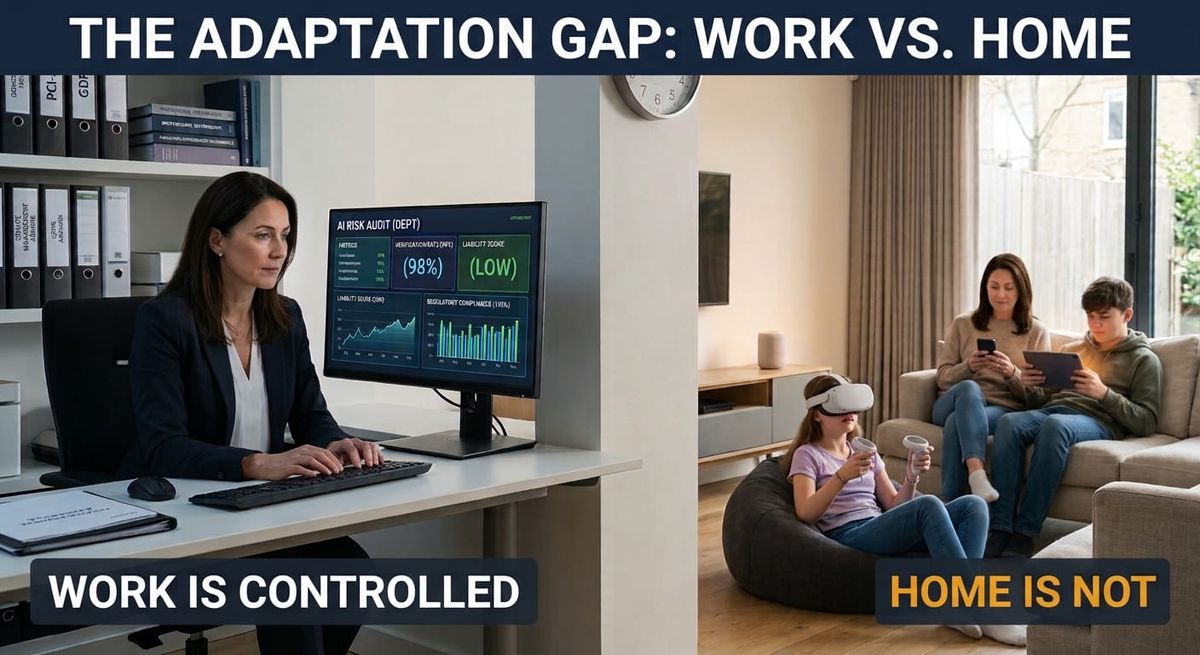
Many professionals can clearly identify AI risks inside their own domain while remaining largely unaware of similar risks in their personal lives.
A dentist immediately understands:
- Liability
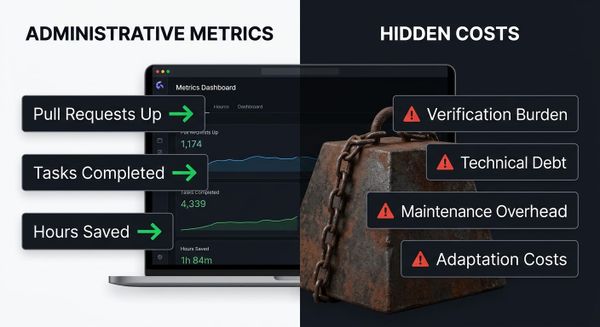
- Verification burden
- Diagnostic risk
- Accountability
inside a clinical environment.
The same person may use:
- AI as entertainment
- Recommendation algorithms
- AI-generated content
- AI-enabled social platforms
without applying the same level of scrutiny.
This is not hypocrisy. It is human behaviour. And this may pass on to their children. Treat education within bounds but home is where we relax guardrails.
🟢 1️⃣ The Social Media Warning
Most adults never consciously chose:
- Algorithmic addiction
- Attention engineering
- Continuous social comparison
- Behavioural influence systems
They chose:
- Convenience
- Communication
- Staying connected
- Keeping up with everyone else
The consequences appeared later. By the time society began debating social-media harms, the technology had already become normal.
The reflection arrived after the adoption.
🟢 2️⃣ The Professional vs Personal Divide
At work:
- AI is audited
- AI is governed
- AI is reviewed
- AI is questioned
At home:
- AI is entertainment
- AI is convenience
- AI is habit
- AI is normal
The same individual can operate in both worlds simultaneously.
Professionals often recognise risk inside their area of expertise while overlooking similar patterns in their everyday lives.
🟢 3️⃣ The Busy Human Problem
Most people are not ignorant.
They are busy with
- Work
- Children
- Parents
- Mortgages
- Bills
- Life
Reflection is expensive. Capability is becoming inexpensive.
Technology enters daily life faster than most people can stop to understand it.
The challenge is not intelligence. The challenge is attention.
🟢 4️⃣ The Adaptation Gap
The AI challenge may no longer be regulation.
- The EU AI Act exists.
- Corporate governance frameworks exist.
- Industry standards exist.
The deeper challenge is adaptation.
Can people adapt quickly enough to understand:
- What AI is doing?
- What assumptions they are making?
- What skills they are outsourcing?
- What habits are changing?
- What forms of judgment are slowly disappearing?
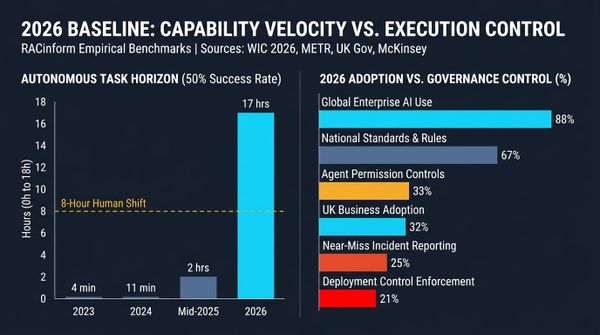
Capability may be accelerating faster than reflection.
Related Framework:
🟢 5️⃣ The Child Test
Children entering the world today will experience AI very differently from previous generations.
For many of them:
- AI will not be new.
- AI will not be remarkable.
- AI will simply be normal.
The same way smartphones became normal. The same way social media became normal.
The question is not whether AI becomes part of daily life.
The question is whether society understands the consequences before normalisation is complete.
Related Reading:
👉 AI Kids
🔵 RACinform View
The greatest AI risk may not be the technology itself.
It may be the speed at which AI becomes normal.
Social media demonstrated what happens when adoption arrives faster than reflection.
AI may accelerate that pattern.
Most people do not deliberately choose behavioural dependence.
They choose convenience.
The challenge is that capability often arrives first. Reflection arrives later.
ASAM exists because adaptation is not automatic.
Humans adapt. Humans do not always adapt fast enough. AI poses the fastest change adaptation in human history.
The question is no longer: "Can AI do it?"
The question may be: "Can society absorb it?"
Related Reading: