AiKids
🔵 RACinform view
Children grow up with two reflections — the one in the mirror and the one shaped by AI. AiKids helps them build clarity early, so their sense of self develops before systems, feeds, and algorithms start shaping it. The series focuses on confidence, independence and transparent thinking, giving families a clean way to navigate early‑age AI without drift.
🟢 Overview: Early‑Age AI Literacy & Safety
AiKids is a clarity‑first framework for sequencing AI after cognition, not before it.
It is designed for parents, educators, and operators navigating early‑age exposure to AI systems, social‑media drift patterns, and dependency‑risk signals. The series documents how children form mental models, how unmonitored systems distort those models, and how structured questioning engines restore clarity.
🟢 Why AiKids Exists?
Children are entering AI systems before they have:
- stable identity formation
- conflict‑processing capacity
- drift‑awareness
- cognitive friction tolerance
Unmonitored AI exposure creates synthetic certainty, conflict‑free zones, and dependency loops that degrade real‑world relational capacity.
AiKids provides a counterweight:
a structured method for sequencing AI only after foundational cognitive skills are in place.
🟢 Core Principles
- Clarity before capability — children must learn how to question before they learn how to use.
- Friction is developmental — conflict‑free AI zones distort relational growth.
- Dependency signals must be visible — early drift patterns are detectable and reversible.
- Parents are operators — not spectators.
- AI is introduced, not discovered — sequencing matters.
Series Components
🟢 Early-Age Questioning Engines
Structured prompts that teach children how to interrogate information, not absorb it.
Examples:
• “What is missing?”
• “Who benefits?”
• “What changes if I disagree?”
• “What is the opposite view?”
These engines build cognitive friction — the antidote to conflict-free AI zones.
🟢 Dependency-Risk Signals
Behavioural markers that indicate early drift:
• excessive certainty
• emotional outsourcing
• avoidance of human friction
• preference for synthetic patience
• identity mimicry
AiKids documents how these signals emerge and how to intervene early.
🟢 Social-Media Drift Patterns
Children raised in algorithmic feeds carry forward:
• attention fragmentation
• reward-loop conditioning
• identity externalisation
• conflict avoidance
AiKids maps these patterns directly to AI-era risks.
🟢 Parent-Operator Guidance
Parents are not passive observers — they are runtime operators.
Guidance includes:
• sequencing rules
• drift-interruption methods
• conversational anchors
• friction re-introduction techniques
• environment resets
🟢 Clean Sequencing for AI Introduction
A step-by-step method for introducing AI only after:
• questioning engines are stable
• drift signals are understood
• relational friction is normalised
• identity boundaries are formed
This is the core of AiKids: AI comes last, not first.
🟢 AiKids Series on Linkedin
The original AiKids series was first published on LinkedIn in June/July 2026. To locate the posts, search: "RACinform + #AiKids"
Key Series topics include:
- The Imagination Gap
- Parent OS Problem
- AI Isn't Magic
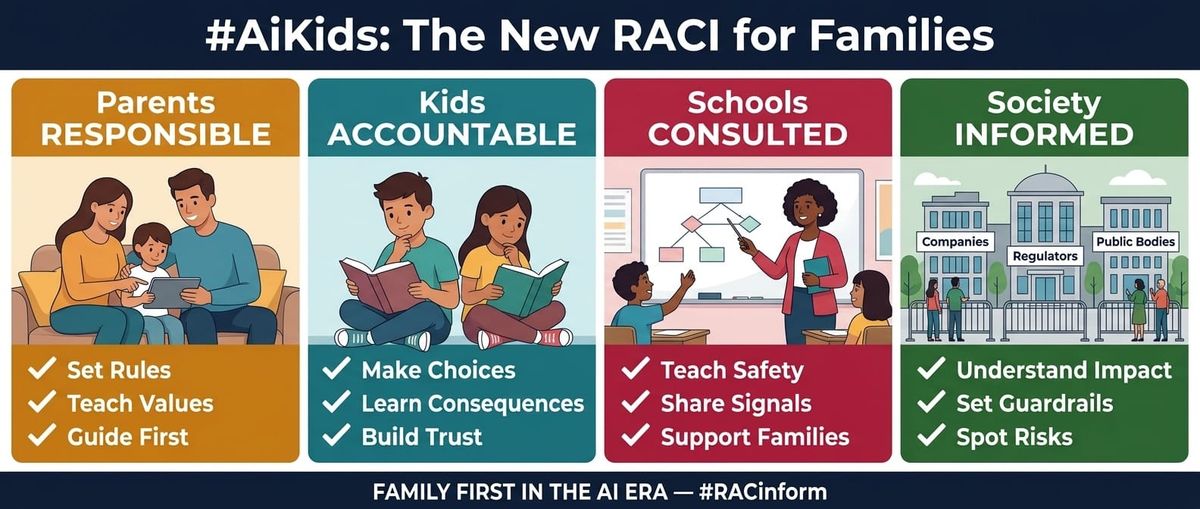
- New RACI for Families
- Second Brain
- Identity Formation
- Risk-Free Friend
- Always-On Coach
- Memory System
- Worldview Filter
🟢 Research & Governance Baseline
- UNICEF
- UNESCO
- OECD
- Ofcom
- Pew
- Stanford HAI
- MIT Teaching Systems Lab
- Harvard Berkman Klein
- DeepMind
- Microsoft Research
- ICO
- DSA
- NSPCC