
The Clock Is The Missing Variable
🟢Overview
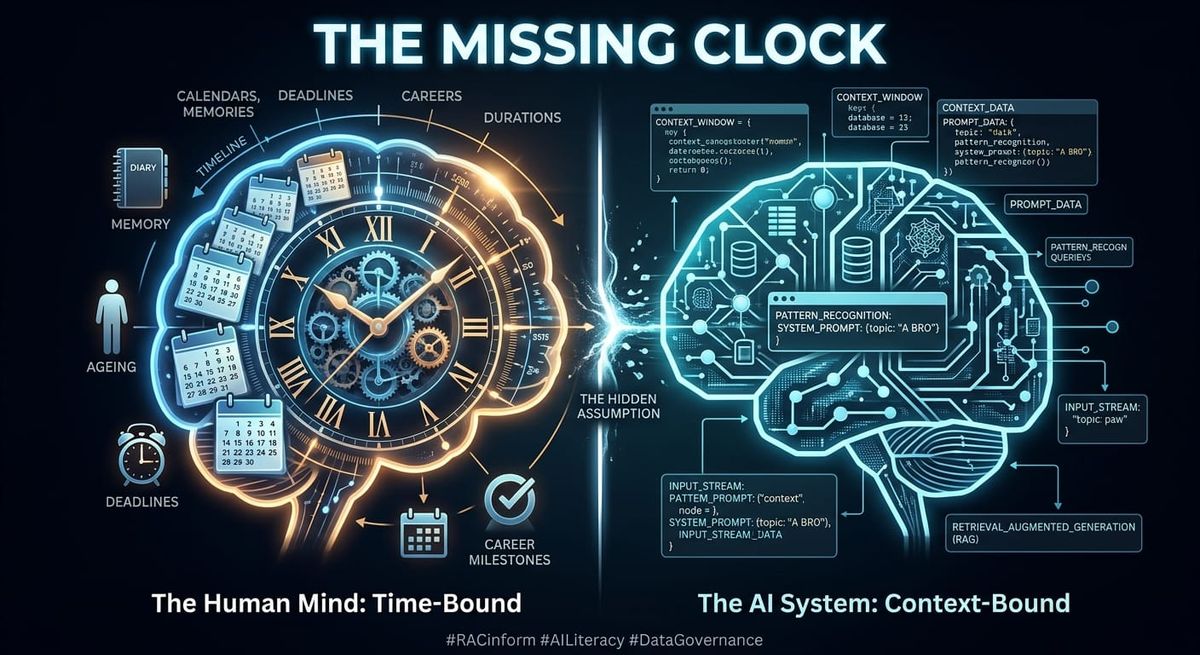
Humans assume time exists in every conversation. AI does not.
This single difference quietly explains many of the strange misunderstandings emerging across modern AI adoption.
The problem is not that AI lacks intelligence.
The problem is that humans unconsciously carry clocks, calendars, durations, anniversaries, ageing, deadlines, careers, memories and life stages into every interaction.
AI does not automatically share those assumptions.
🟢The Hidden Assumption
A human can say:
- "I've been working on this for years."
- "Sorry, that was a long break."
- "We discussed this last month."
- "It took ages."
Humans immediately understand the timeline. The timeline exists inside their heads.
AI only knows what is present in the available context.
When timestamps are absent, durations become assumptions rather than observations.
This often leads to phrases such as:
- For years
- All year
- All week
- For months
even when the duration has not actually been observed.
The timeline has been inferred rather than measured.
🟢Why This Matters
Most AI discussions focus on:
- Capability
- Performance
- Accuracy
- Safety
Far fewer discussions focus on:
- Temporal assumptions
- Human memory
- Context continuity
- Timeline reconstruction
Yet many AI misunderstandings originate here.
Humans naturally fill missing time gaps. AI naturally fills missing information gaps.
The two mechanisms are similar but not identical.
🟢The Dangerous Fix
Many people respond: "Give AI a clock."
At first glance this appears reasonable. In practice it creates a different problem.
To truly understand time, AI systems would need increasing levels of:
- Behaviour tracking
- Interaction logging
- Timeline reconstruction
- Usage-frequency analysis
- Long-term behavioural telemetry
At that point, the system begins moving beyond conversation and toward behavioural surveillance.
This immediately creates new governance, privacy and compliance questions.
The cure may become worse than the disease.
🟢The Better Fix: User Literacy
The solution is not necessarily more telemetry. The solution may be simpler.
Teach people how AI actually works.
Humans are:
- Time-bound
- Memory-bound
- Energy-bound
- Life-bound
AI is primarily:
- Context-bound
- Pattern-bound
- Prompt-bound
Understanding this distinction eliminates many unrealistic expectations. It also prevents users from attributing human properties to non-human systems.
🟢The Governance Lesson
The AI era is exposing hidden assumptions humans rarely notice because every human already possesses them.
Time is one of those assumptions. Most people never think about clocks because clocks are everywhere.
Only when interacting with AI does the absence become visible.
The clock is not broken. The clock was never there.
🔵RACinform View
Many AI errors are not technical failures. They are human assumptions colliding with machine reality.
Humans live inside time. AI lives inside context.
When timestamps are absent, AI may generate plausible timelines that feel reasonable but were never actually observed.
The fix is not necessarily adding more tracking. The fix is teaching the limitation.
Understanding where AI begins and where human assumptions end may be one of the most important literacy skills of the AI era.
Related links:
👉ASAM