The Phantom Productivity Trap: Real-World Failures of AI Productivity Metrics
🟢 Overview
The AI productivity debate is increasingly dominated by activity metrics.
- Pull requests.
- Tasks completed.
- Hours saved.
- Token consumption.
- Licences deployed.
The problem is that activity is easy to measure. Value is not.
Many organisations report productivity gains while lacking a verified baseline for quality, maintainability, verification effort and downstream operational impact.
The result is phantom productivity.
Activity increases. Value remains unclear.
🟢 1️⃣ The GitHub Copilot Volume Trap
Large-scale studies have shown increases in developer output, including higher pull request volumes.
The problem is not the increase in output but the absence of a verified quality baseline.
Without measuring:
- Technical debt
- Defect rates
- Maintenance effort
- Review overhead
- Downstream support costs
organisations cannot determine whether productivity genuinely improved or whether they simply increased output without proving equivalent gains in quality, maintainability or business value.
More output is not automatically more value.
🟢 2️⃣ The Dropbox Exception
One of the more interesting approaches combines standard telemetry with direct workforce feedback.
Rather than measuring output alone, engineers are asked at the point of task completion:
- Did AI make this easier or harder for the next person?
This shifts the focus from activity to consequence.
❌ Not Time Saved but ✅ Human Cost
The question goes directly into adaptation territory.
Value is not created when work is completed but when work remains understandable, maintainable and useful after completion.
🟢 3️⃣ The Frontier Dependency Tax
Many AI ROI calculations underestimate a growing dependency burden.
Examples include:
- Dynamic token pricing
- Consumption-based billing changes
- Prompt-chain lock-in
- Model-specific workflow coupling
- Vendor migration costs
- Runtime dependency management
As organisations become increasingly dependent on specific frontier providers, changing provider may remain technically possible while becoming economically painful.
The capability appears flexible. The dependency becomes increasingly fixed.
🟢 4️⃣ The Missing Metric
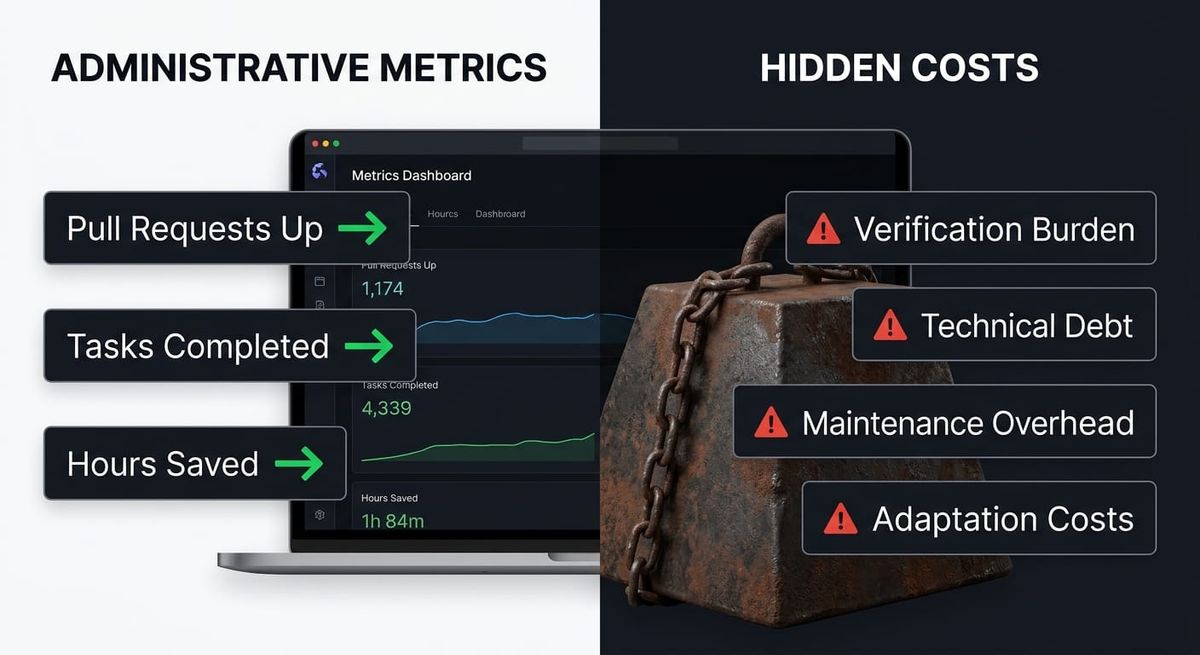
Most organisations measure:
- Time saved
- Tasks completed
- Copilots deployed
Very few measure:
- Verification effort
- Rework effort
- Maintenance effort
- Exception-handling effort
- Adaptation effort
The result is phantom productivity.
The organisation measures activity while ignoring the growing effort required to validate, maintain and absorb the output.
🔵 RACinform View
Productivity is not measured by what AI produces but by what disappears.
If a workflow still requires the same meetings, approvals, reviews, escalations and validation steps, the organisation has not eliminated work. It has merely redistributed it.
Administrative productivity metrics were designed for deterministic systems.
Agentic systems introduce:
- Verification burden
- Runtime drift
- Maintenance overhead
- Adaptation costs
- Governance effort
that rarely appear in traditional productivity reporting.
Until productivity metrics capture verification, maintenance and adaptation costs, many AI success stories will remain estimates rather than proof.