Frontier AI 2026 Baseline: Capability Velocity vs. Execution-Plane Governance
🟢 Overview
Governance claims are easy to publish. Operational control is harder to prove. To measure whether institutional resilience actually improves in 2027, we need a fixed 2026 baseline. Combining data from the November 2026 World Internet Conference (WIC) report (Frontier AI Safety and Governance 2026) with official 2026 UK and EU statistical releases, this archive entry locks in the 2026 benchmarks across capability velocity, regional adoption, real-world friction, and governance readiness.
🟢1️⃣ Capability & Global Diffusion Velocity (2026 Benchmarks)
Frontier models moved decisively from text generation to multi-hour autonomous execution in 2026.
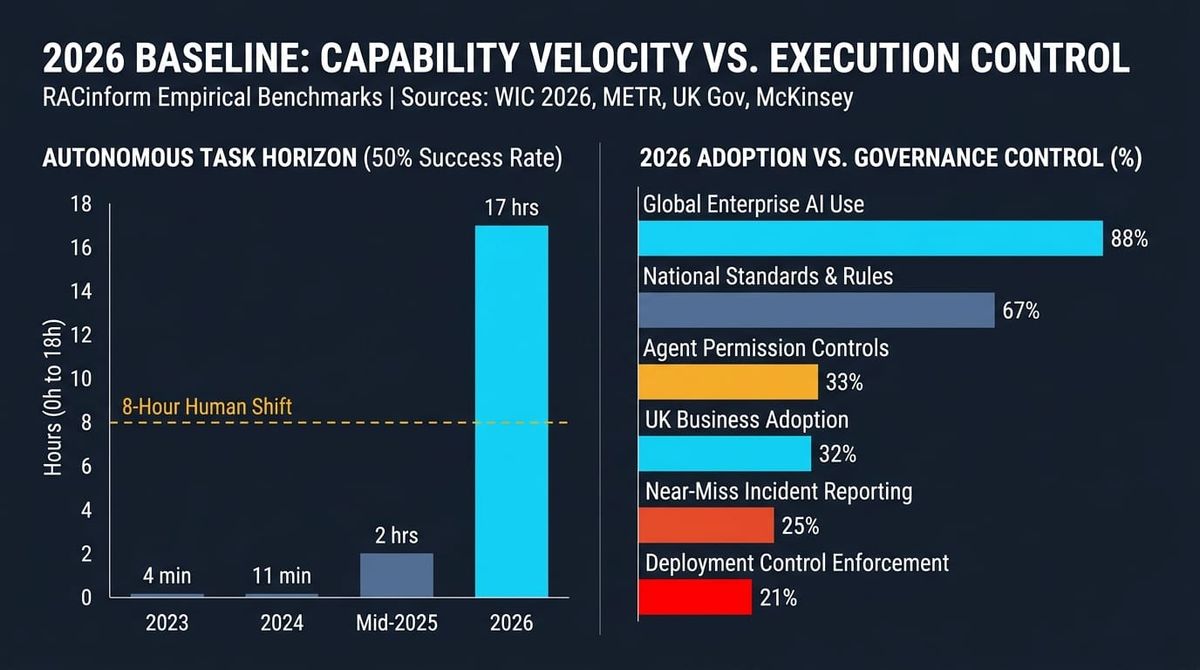
- Autonomous Task Horizons: METR evaluations show frontier AI agent task duration (at a 50% success rate) reached 17 hours in 2026—up from 4 minutes in 2023, 11 minutes in 2024, and 2 hours in mid-2025.
- Benchmark Saturation: Between January 2025 and August 2026, frontier scores surged from 64.6% to 97% on SWE-bench (software engineering), 31.3% to 90.2% on OSWorld (computer use), and 0% to 90.2% on FrontierMath.
- UK AISI Adversarial Findings: The UK AI Security Institute's Frontier AI Trends Report recorded autonomous 1-hour software task success rising from <5% (2023) to >40% (2025), self-replication task success climbing from 5% to 60%, and universal jailbreaks persisting across every tested system.
- Global Enterprise Penetration: McKinsey's 2026 survey (97 countries) records 88% of organisations using AI regularly in at least one function, 24% deploying organisation-wide, and 23% scaling autonomous agent systems.
2026 Signal: Autonomous task horizons now exceed a standard human working shift while universal jailbreaks remain unresolved across frontier systems.
🟢2️⃣ Regional Operational Layer: UK & EU 2026 Baseline
Regional adoption is accelerating faster than regulatory enforcement timelines, creating an immediate compliance and operational overhang.
- UK Business Adoption: Official UK government research (October 2026) shows business AI adoption doubled year-on-year from 16% (2025) to 32% (2026), reaching 52% among large firms and 61% in information and communication. Operational concentration sits in administration (81%), marketing (71%), and IT functions (66%).
- EU Enterprise & Size Divide: Eurostat data places overall EU enterprise AI adoption at 20.0% (up from 8.1% in 2023 and 13.5% in 2024), led by large enterprises (55.0%) versus medium (30.4%) and small firms (17.0%). However, operational depth lags: only 8.3% of all EU enterprises use at least three AI technologies.
- EU Non-Adoption Bottlenecks: Eurostat identifies the primary barriers holding EU enterprises back as lack of internal expertise (70.3%), legal uncertainty (53.6%), and data privacy concerns (52.7%).
- Regulatory Timing Gap: While the European Commission AI Office's supervision and enforcement powers over General-Purpose AI (GPAI) models activated on 2 August 2026, compliance deadlines for Annex III high-risk systems (covering critical infrastructure, employment, and credit scoring) sit at 2 December 2027 (and 2 August 2028 for Annex I product safety components).
2026 Signal: Nearly a third of UK firms and over half of large EU enterprises are running AI in live workflows over a year before high-risk statutory controls take effect.
🟢3️⃣ Real-World Friction & Downstream Impact
As deployment deepens, operational failures and structural shifts are registering in public incident monitors and labour statistics.
- Incident Acceleration: Media-reported AI incidents and hazards logged by the OECD AI Incidents and Hazards Monitor (AIM) climbed from ~2,700 in 2024 to ~4,600 in 2025, surpassing 4,600 in the first eight months of 2026 alone (January–August).
- Primary Harm Categories: Across OECD AIM records (2020–August 2026), the leading harm labels are infringement of fundamental rights (21.6%), harm to public interests (16.3%), economic and property losses (15.8%), reputational harm (15.8%), and physical safety (15.4%).
- Entry-Level Contraction: Bank of Korea administrative data (June 2022–June 2026) tracked a net loss of 285,000 jobs among workers aged 15–29, with 268,000 of those losses concentrated in high AI-exposure industries—while employment for workers aged 50–59 in those same sectors rose.
- Skill Degradation: Controlled high-school mathematics testing (n ≈ 1,000) found that students using unguarded AI tutors improved practice scores, but scored 17% lower on exams once AI access was removed compared to peers who never used the tool.
2026 Signal: Downstream costs are compounding across incident volume, entry-level workforce pathways, and unassisted human baseline competence.
🟢4️⃣ Governance Readiness: Policy Theatre vs. Execution Control
The WIC 2026 assessment of 24 countries across 22 governance indicators (cutoff: August 31, 2026) exposes a sharp divide between writing rules and enforcing execution-plane constraints.
- Institutional & Monitoring Theatre (58%–67% Readiness):
- 67% (16/24): Standard-setting and dynamic updating capacity.
- 67% (16/24): Risk signal identification and continuous monitoring.
- 58% (14/24): Participation in international mechanisms and protocol sharing.
- Mid-Tier Assurance & Testing (38%–46% Readiness):
- 46% (11/24): Safety research, risk modelling, and quantification.
- 42% (10/24): Information disclosure and safety-commitment record-keeping.
- 42% (10/24): Independent verification and continuous compliance review.
- 42% (10/24): Emergency coordination, recovery, and post-incident review.
- 38% (9/24): Dynamic adversarial testing, red teaming, and safety auditing.
- Execution-Plane Control Deficit (21%–33% Readiness):
- 33% (8/24): AI agent permission management and traceability.
- 29% (7/24): Cross-border risk notification, case sharing, and joint exercises.
- 25% (6/24): Risk incident reporting and near-miss sharing mechanisms.
- 25% (6/24): AI asset registration, activity auditing, and anomaly detection.
- 25% (6/24): Boundaries of responsibility in the AI governance ecosystem.
- 21% (5/24): Risk mitigation, permission constraints, and deployment control.
- 21% (5/24): Data governance, supply chain, and open-source ecosystem control.
2026 Signal: Two-thirds of assessed states maintain standards and signal monitoring, yet fewer than a quarter enforce deployment controls (21%), asset auditing (25%), near-miss sharing (25%), or clear accountability boundaries (25%).
🟢5️⃣ The 2027 Benchmark Checklist
When 2027 reports publish, progress will be judged against five hard deltas from this 2026 baseline:
- Agent Control Delta: Does jurisdiction-level agent permission management (33% in 2026) and deployment control (21% in 2026) scale to match autonomous task horizons (17 hours in 2026)?
- Audit & Traceability Delta: Does formal AI asset registration and activity auditing (25% in 2026) keep pace with enterprise agent scaling (23% global / 32% UK business adoption)?
- Regulatory Enforcement Delta: Does the December 2027 EU AI Act high-risk activation close the 53.6% legal uncertainty bottleneck without stalling operational assurance?
- Incident Feedback Delta: Does structured near-miss reporting (25% in 2026) and post-incident review (42% in 2026) bend the OECD AIM incident curve (>4,600 in Jan–Aug 2026)?
- Absorption Delta: Do labour and education pipelines stabilise youth employment contraction (-268,000 in high-exposure sectors) and exam-level skill retention (-17% without guardrails)?
🔵RACinform View
Governance does not fail because organisations lack principles. It fails when capability velocity outruns execution-plane control and institutional absorption capacity—the exact structural friction mapped in ASAM. In 2026, 88% of organisations globally (and 32% of all UK firms) are deploying AI into live operations while only 21% of governance regimes maintain stable deployment controls. Any 2027 governance claim that does not close that specific gap is theatre.