AI DC Waste Heat in 2026: How Countries Are Actually Harvesting Compute Exhaust
🟢 Overview
The public debate around AI datacentres stops at megawatts consumed and GPUs deployed. Rarely does it examine what happens when operators actually try to plug massive thermal exhaust into local municipal grids.
As detailed in the core framework AI DC Waste: The 80:20 Rule of AI Infrastructure, capturing 100% of datacentre heat year-round is blocked by two physical realities: low exhaust temperatures from legacy air cooling and the summer drop-off in residential heating demand.
Yet across 2026, direct-to-chip liquid cooling (outputting 50°C–60°C+ return water instead of 30°C air) has shifted the unit economics—turning waste heat from an ESG talking point into hard national infrastructure policy. Here is how execution actually looks across major markets.
🟢 1️⃣ Finland: The Municipal District Blueprint
Finland has built the operational benchmark for circular thermal energy despite severe summer demand slumps (where hot water demand drops to roughly a quarter of winter median):
Related link: 👉Finnish Energy Data
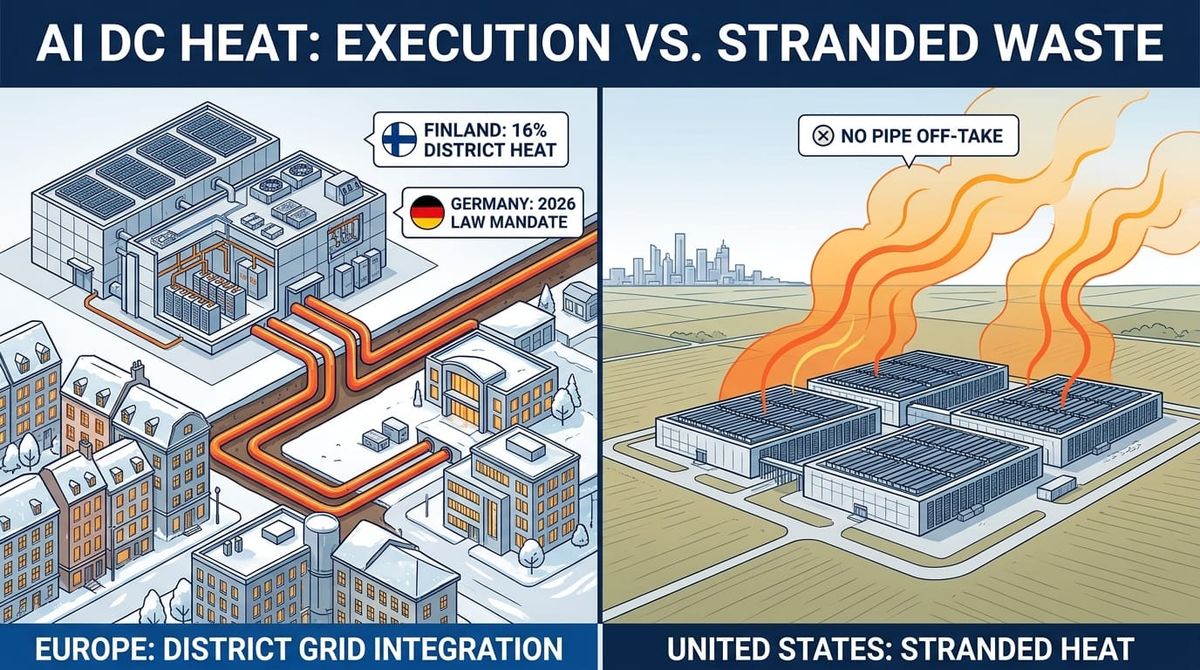
- National Scale: According to Finnish Energy data, 16% of Finland’s entire district heat supply already comes from heat recovery (up from 2% in 2010), pushing climate-neutral heating to 73% of the national mix.
- Google (Hamina): Engineered to cover roughly 80% of its local district's annual heat demand.
- Microsoft & Fortum: Built to supply 40% of the heating needs across Espoo, Kauniainen, and Kirkkonummi—serving roughly 250,000 homes and businesses.
🟢 2️⃣ Germany: Statutory Mandate Over Voluntary Adoption
While the Nordics scaled through mature municipal pipe networks, Germany chose hard regulation:
- The Energy Efficiency Act (EnEfG): New datacentres above 300 kW are legally required to reuse at least 10% of their waste heat starting July 2026, scaling to 15% in 2027 and 20% by 2028.
Enforcement Reality: Non-compliance carries statutory fines, forcing hyperscalers to lock in thermal off-take agreements before breaking ground.
🟢 3️⃣ Denmark & Sweden: Mature Underground Pipe Integration
Scandinavia leads because the underground municipal distribution networks already exist:
- Denmark: Meta’s Odense facility recovers roughly 100 GWh of heat annually (warming nearly 7,000 homes), while Microsoft's Høje-Taastrup campus is engineered to heat another 6,000 households.
- Sweden: Stockholm has fed server exhaust into its municipal grid since 2014 via industrial heat pumps, supplying 10% to 20% of the city's network demand.
🟢 4️⃣ The Netherlands & Ireland: Heat Export as a Licence to Operate
Where datacentre expansion has strained national power grids, thermal recovery has become a prerequisite for planning approval:
- The Netherlands: Operators including Digital Realty partner directly with utilities like Vattenfall Warmte in Amsterdam to feed hyperscale heat into residential loops.
- Ireland: Facilities such as AWS in Dublin supply over 90% of the heating demand for neighbouring commercial and public district zones.
🟢 5️⃣ The United States: The Stranded Infrastructure Bottleneck
Despite hosting roughly 4,000 datacentres—more than any other nation—the U.S. vents almost all AI waste heat straight into the atmosphere:
- The Proximity Failure: Outside isolated campus loops (such as Amazon’s Seattle headquarters), U.S. hyperscalers build where land and power are cheapest—miles away from dense residential heating pipes.
The Result: Without municipal thermal grids, gigawatts of recoverable thermal energy have nowhere to go.
🟢 6️⃣ UK, Canada & Aus/NZ
Outside continental Europe and the U.S., the rest of the Western market splits along two sharp constraints: legacy pipe scarcity and climate physics.
- The United Kingdom (Policy Catch-Up, Pipe Deficit):
Despite classifying DCs as Critical National Infrastructure and backing early heat-network schemes (such as West London’s Old Oak and Park Royal project and DESNZ-funded Thames heat-network initiatives), the UK lacks a binding statutory mandate comparable to Germany’s EnEfG. Most UK facilities still sit outside zoned district-heating networks, leaving recovery reliant on voluntary commercial negotiations and local planning conditions.
- Canada (High Climate Demand, Stranded Grids):
Cold winters and cheap hydro power make Canada an obvious candidate for thermal recovery, yet it mirrors the U.S. bottleneck. Outside isolated municipal loops, hyperscale campuses are largely built on cheap industrial land disconnected from dense residential district-heating pipes.
- Australia & New Zealand (Cooling-Dominated Physics):
In Australia, residential heating demand is minimal across major metro hubs, meaning traditional district heating has almost zero economic pull and no statutory mandate exists.
New Zealand has taken a pragmatic, site-by-site stance—rejecting universal mandates while targeting niche industrial or commercial off-takers (such as adjacent manufacturing or recreational facilities) where commercial agreements stack up.
🔵 RACinform View
Compute is no longer just an electrical load. It is a thermal asset.
However, harvesting it is not purely an AI hardware problem—it is an urban planning and governance problem. Countries with existing district heating pipes, liquid-cooled racks, and statutory mandates are turning server exhaust into low-carbon local heat.
Regions building hyperscale campuses in isolated rural corridors without off-take infrastructure are locking in permanent 100% atmospheric waste.
Related Framework & Reading:
👉 AI DC Waste: The 80:20 Rule of AI Infrastructure
👉 AI DC: Infrastructure, Power & Allocation
👉 The Phantom Productivity Trap