
AI DC: When AI Stops Being Digital
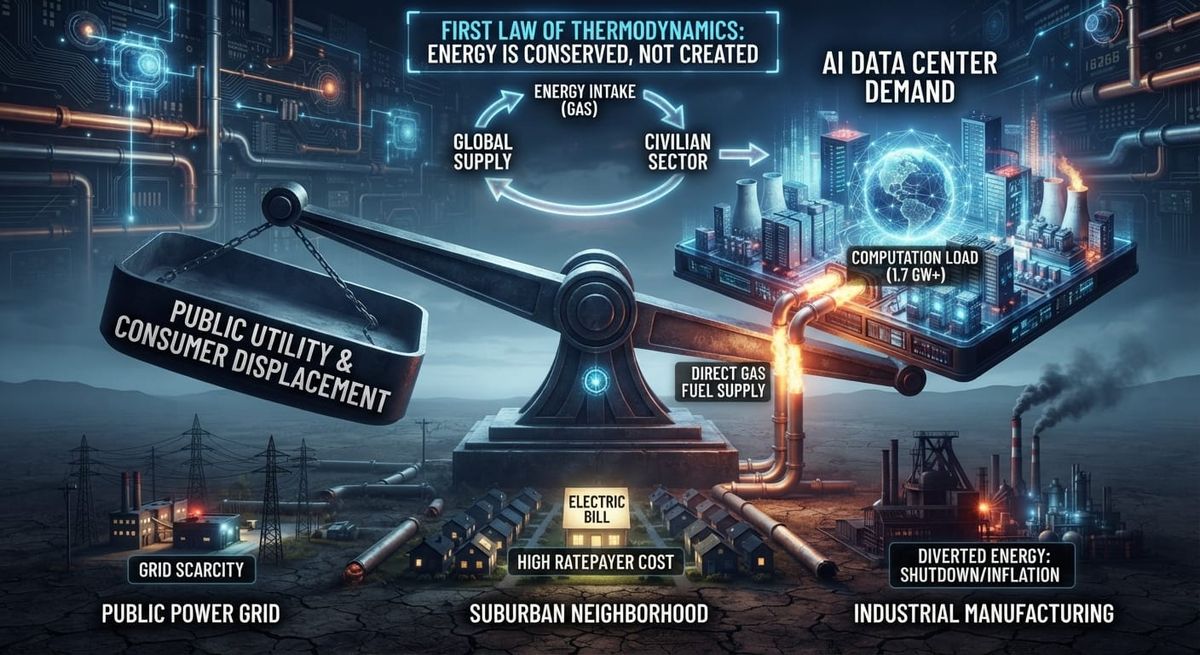
🟢The Shift Nobody Is Talking About
For years, AI was treated as a software problem: More compute | More models | More engineers | More algorithms
That era is ending.
AI is rapidly becoming an infrastructure problem: Power | Gas | Water | Cooling | Land | Transmission | Permitting
The conversation is no longer: "Can we build better models?"
The conversation is becoming: Where do the physical inputs come from?
🟢 Scarce Infrastructure Gets Allocated
AI does not create energy.
AI consumes energy.
Datacentres do not manufacture power.
They compete for power.
(News 09Nov2026: Anthropic AI lab’s $3.4bn deal with OnePWR Solution for gas-fired generators to power datacentres.)
When a frontier AI company secures priority access to generation capacity, gas supply, cooling infrastructure, transformers, transmission assets or equipment queues, resources are diverted from alternative uses.
This is not a moral statement. It is an allocation statement.
Infrastructure allocated to one user is infrastructure unavailable to another user until additional capacity is built.
The question is not whether AI deserves access.
The question is who moves down the queue.
🟢 The New AI Resource Economy
Historically, AI competed for:
- Talent | Data | Compute
Increasingly it competes for:
- Electricity | Natural gas | Water | Cooling capacity | Transmission capacity | Transformers | Construction labour | Industrial equipment
These inputs are physical.
They are finite.
And they must be allocated.
🟢 The Infrastructure Illusion
Many people still think AI exists inside screens. That is no longer true. Every large AI model increasingly depends on:
- Datacentres | Power stations | Pipelines | Cooling systems | Transmission networks | Physical supply chains
The AI economy is now inseparable from the physical economy.
Every major AI deployment becomes a discussion about:
- Land | Water | Power | Community impact | Planning permission | Infrastructure investment
Who Pays?
When scarce infrastructure gets allocated, costs do not disappear. They move.
Common outcomes include:
- Queue displacement
- Higher infrastructure costs
- Delayed industrial projects
- Utility investment requirements
- Grid upgrade costs
- Increased consumer charges
The physical economy absorbs whatever the digital economy requires.
🟢 The Governance Question
The debate is no longer: "Can AI scale?"
The debate is becoming: "How should scarce infrastructure be allocated?"
When infrastructure is constrained:
- Someone receives priority access.
- Someone moves down the queue.
- Someone pays more.
Nobody escapes the trade-off.
These are governance decisions as much as engineering decisions.
🟢 Contextual Resource References
Primary source graphs:
- For a clear illustration of the overall surge, refer to the Nature Data-Centre Energy Growth Chart @ https://nature.com
- To show exactly where the power generation splits stand, see the Statista Data Center Energy Supply Breakdown @ https://statista.com
- For a breakdown of the infrastructure challenges, utilise the U.S. Global Investors AI vs. Power Grid Infographic @ https://topforeignstocks.com
🔵 RACinform View
The AI era is entering a new phase. For years the dominant bottlenecks were: Software; Models; Training and Compute.
Increasingly the bottlenecks are becoming: Energy; Water; Land and Physical infrastructure
Scarce infrastructure gets allocated.
- Allocation creates winners.
- Allocation creates costs.
- Allocation creates consequences.
AI is no longer merely a software discussion. It is increasingly an infrastructure discussion.
The challenge is no longer what AI can do.
The challenge is how societies choose to distribute the resources that make AI possible.