
AI DC Waste: The 80:20 Rule of AI Infrastructure
🟢 Overview
The public debate around AI datacentres fixates on a single input question: "How much power does AI consume?"
The real operational question is different:
"What output resources are we still treating as disposable waste?"
AI DCs consume massive electrical loads and convert nearly all of that energy into heat. For decades, standard infrastructure design treated thermal output as a pure liability—something to be expensively rejected into the atmosphere.
Now, high-density AI deployments are forcing a basic architectural shift: treating waste heat as a recoverable asset.
🟢 1️⃣ The Linear Waste Model
Most infrastructure critiques track inputs and externalities:
• Grid draw and substation capacity
• Water consumption for evaporative cooling
• Scope 2 carbon footprint
Those metrics matter. Yet they share a blind spot: they assume thermal output has zero downstream utility.
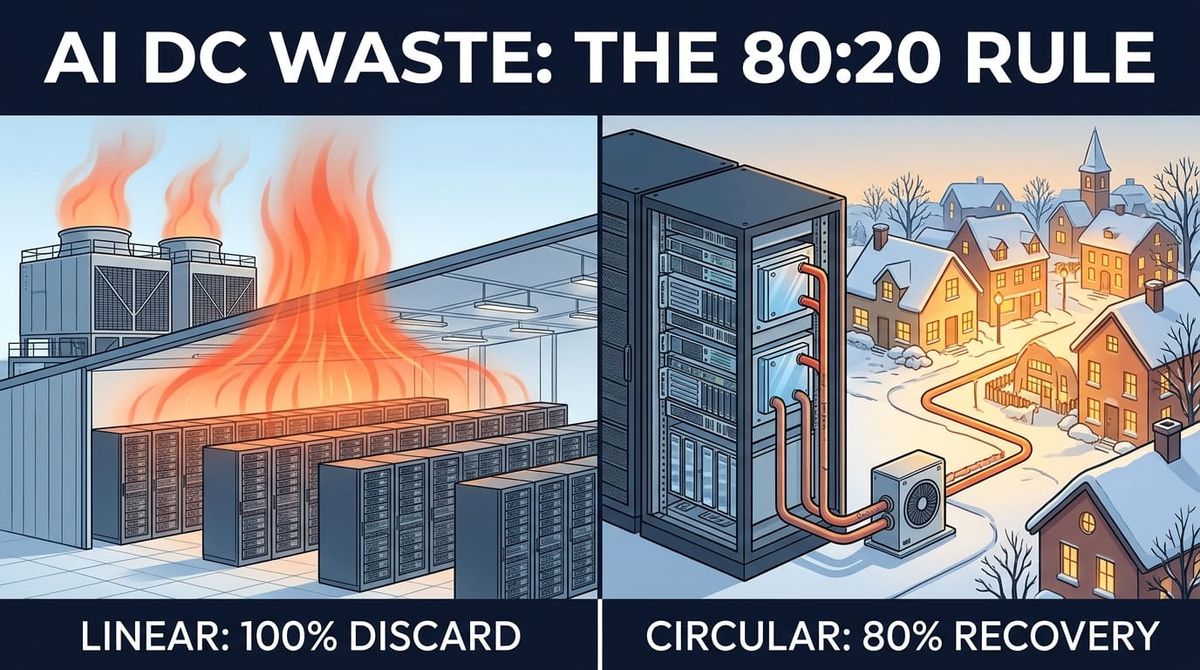
The resulting architecture is strictly linear:
Electricity ➡️ Computation ➡️ Low-Grade Heat ➡️ Atmospheric Discard
You pay once to bring power in, and pay a second time to push heat out.
🟢 2️⃣ The Circular Resource Model
When DCs are co-located near urban or industrial demand—and particularly as liquid cooling raises exhaust temperatures—that thermal stream becomes usable feedstock for district-heating networks.
The model shifts from linear disposal to secondary extraction:
Electricity ➡️ Computation ➡️ Captured Thermal Output ➡️ Heat Pump Upgrade / District Loop ➡️ Homes & Local Industry
This does not generate new energy. It extracts a second economic and physical yield from electrons already paid for. The shift is from endlessly expanding supply to improving end-to-end utilisation.
🟢 3️⃣ The Summer Objection & Engineering Reality
Two valid engineering objections always surface immediately:
• The Grade Problem: Traditional air-cooled halls produce low-grade heat (25°C–35°C), requiring heat pumps and capital spend to reach district-heating temperatures.
• The Summer Problem: Residential heating demand collapses in summer while AI compute runs 24/7.
Both constraints are real. District recovery requires physical proximity, thermal storage, or industrial off-takers (such as greenhouses, water treatment, or manufacturing) during warmer months.
However, an unresolved summer surplus does not invalidate a high-yield winter baseline. An engineering constraint is not a reason to discard the entire model.
🟢 4️⃣ The 80:20 Rule of Infrastructure Recovery
Public and executive debates routinely evaluate infrastructure using an all-or-nothing standard: Either solve 100% of the thermal loop year-round, or reject heat recovery entirely.
Systems rarely work that way. In practice, capturing the high-demand seasonal window delivers the majority of economic and carbon value without over-engineering for edge-case summer storage.
The baseline comparison is never:
Perfect Closed-Loop System vs. Imperfect System
The operational comparison is always:
Partial Recovery vs. 100% Atmospheric Waste
A resource recovered for seven months of the year beats a resource vented into the sky for twelve.
🟢 5️⃣ The Broader Governance Pattern
This exact blind spot appears across enterprise IT and AI deployments:
• Compute vs. Cleanup: Organisations buy more GPU capacity and AI licences while leaving redundant legacy workflows and unretired processes burning runtime.
• Supply vs. Utilisation: Leadership chases new capability while ignoring recoverable capacity already sitting inside existing catalogues and pipelines.
In physical infrastructure and software governance alike, the fastest efficiency gain rarely comes from buying more supply but from stopping obvious waste.
🔵 RACinform View
The objective is not thermodynamic perfection. The objective is waste reduction.
Datacentre heat recovery will not solve national grid constraints or eliminate summer cooling loads. It was never designed to. What it does is convert an expensive disposal problem into a measurable community asset.
The summer surplus remains an engineering problem to solve. The winter recovery gain remains real today.
Dismissing an 80% operational improvement because it leaves 20% unresolved is not rigour—it is inertia. Whether governing power grids, AI workloads, or enterprise workflows, partial recovery always beats total waste.
Related Reading:
👉 AI DC Waste Heat in 2026: Harvesting Compute Exhaust by countries
👉 AI DC: Infrastructure, Power & Allocation
👉 AI ROI
👉 The Phantom Productivity Trap
👉 ASAM – Adaptation Safety & Absorption Model