Why AI ROI Often Fails?
🟢The Core Observation
Many discussions around AI focus on revenue growth, productivity gains and new capabilities.
Far fewer focus on an equally important question:
What unnecessary work still exists?
Before organisations ask, "How do we automate this?", they should ask:
Do we still need this at all?
🟢The Hidden Cost Problem
Most organisations accumulate processes over time.
- Approvals are added.
- Reports are added.
- Reviews are added.
- Meetings are added.
- Documentation is added.
Very few activities are ever removed.
As a result, AI often arrives in an environment where operational waste already exists.
The outcome becomes:
✔️ Old Workflow + New AI Workflow + Verification ➡️ More Complexity
❌ Not More Productivity
🟢The Leadership Mistake
Many executives naturally focus on and celebrate visible headline changes:
- Revenue growth
- New customers
- New products
- New technology
Cost reduction rarely receives the same attention.
The Math: If a company operates on a 10% net profit margin, every $100 from new sales yields just $10 in profit. But if that same company eliminates $10 of waste, that full $10 goes straight to the bottom line.
The Ratio: Because of this dynamic, a 1% reduction in operational waste has the exact same impact on your balance sheet as a 10% to 12% increase in sales.
Selling is harder than not wasting. But removing waste requires challenging assumptions.
✔️Growth creates excitement. ❌Retirement creates resistance.
🟢The Workflow Retirement Question
Before deploying AI, organisations should ask:
1️⃣Do we need this process at all?
- Can it be removed?
- Can approvals be reduced?
- Can requirements be retired?
- Can duplication be eliminated?
If yes, retire the work first.
2️⃣Can existing tools solve the problem?
- Can current systems deliver the outcome?
- Can existing workflow tools help?
- Can current automation capabilities be used?
If yes, use them.
3️⃣Is the real problem skills?
- Do employees understand the available tools?
- Can training solve the problem?
- Can operational capability be improved?
If yes, invest in people before replacing platforms.
4️⃣Only then consider new AI
New AI should solve a proven gap.
⚠️ The Governance Risk: AI can speed up workflows, but throwing unnecessary AI into the mix only increases operational risks and drives up hidden costs.
🟢The Adaptation Gap
Many AI projects fail to produce meaningful ROI because organisations attempt to automate workflows they never questioned.
Technology accelerates activity. It does not determine whether the activity creates value.
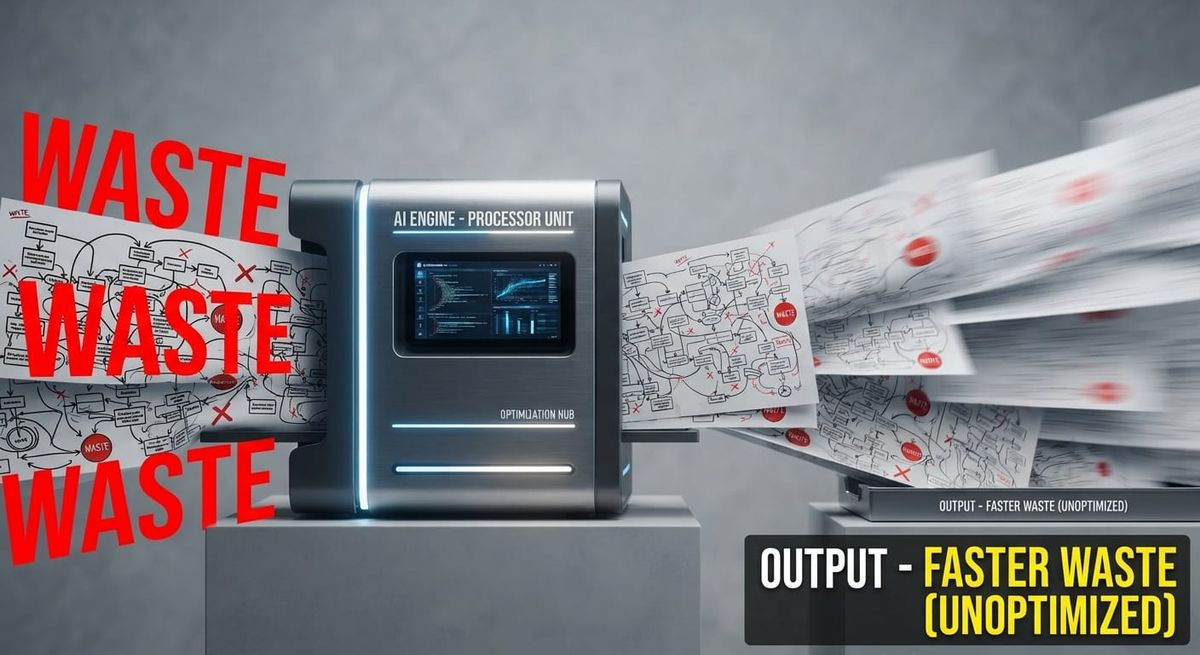
Automating waste simply produces faster waste.
🔵RACinform View
AI ROI is often presented as a technology challenge.
It is more frequently a leadership challenge.
The difficult question is rarely: "Which AI should we buy?"
The difficult question is: "Which work should disappear?"
Sustainable productivity gains appear when organisations:
- Retire obsolete work
- Reduce operational waste
- Simplify workflows
- Improve accountability
- Change behaviour
Only then does automation compound value.
Leadership is not only measured by revenue growth.
Leadership is also measured by the unnecessary cost, effort and complexity that never reach the balance sheet.
Related links:
👉ASAM