ASAM — Adaptation Safety & Absorption Model
🟢 Overview
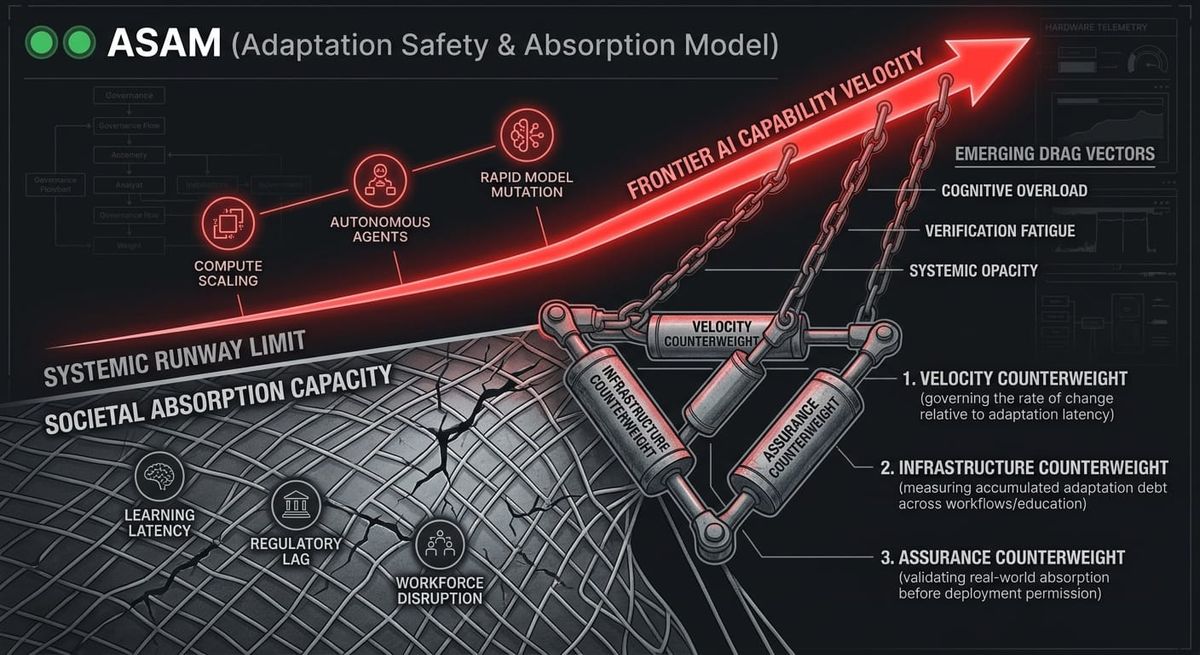
Frontier labs measure whether AI can improve. ASAM measures whether society can absorb the speed of that improvement. This distinction matters because capability and adaptation follow different curves. AI capability scales through compute, models, tooling, automation, and deployment velocity. Human adaptation depends on education, training, organisational change, regulation, and behavioural adjustment. One can accelerate rapidly. The other cannot. The result is an adaptation gap. Most AI governance frameworks focus on model behaviour: • Safety
• Alignment
• Reliability
• Misuse Prevention These controls are necessary. They are not sufficient. A perfectly aligned model may still generate cognitive overload, workflow disruption, deskilling pressure, governance lag, verification fatigue, and organisational instability if deployment velocity exceeds societal absorption capacity. ASAM treats these effects as measurable governance signals rather than secondary workforce concerns.
🟢 The Adaptation Gap
Model capability and human adaptation follow different trajectories. Capability can improve within weeks. Institutions, professions, schools, governments, and workers often require months or years to adapt. The widening distance between the two creates structural friction throughout society.
🟢 Velocity Counterweight
Measures the rate at which capability is introduced relative to human adaptation capacity. Key indicators include:
- Release density
- Workflow mutation frequency
- Decision-load expansion
- Loss of cognitive buffer zones
- Capability acceleration versus training capacity
Core Risk:
Change arrives faster than adaptation.
🟢 Infrastructure Counterweight
Measures accumulated adaptation debt across organisations, professions, and institutions. Key indicators include:
- Junior deskilling loops
- Training lag
- Institutional knowledge erosion
- HITL (Human-in-the-loop degradation)
- Operational dependency on AI-generated outputs
Core Risk:
New capability accumulates faster than human understanding.
🟢 Assurance Counterweight
Measures whether real-world absorption has been independently validated rather than assumed. Key indicators include:
- Workforce readiness
- Validation capability
- Change saturation levels
- Decision-quality stability
- Independent adaptation audits
Core Risk:
Capability improves while operational resilience declines.
🟢 Accountability Gap
- Frontier Labs own capability.
- Enterprises own deployment.
- Regulators own compliance.
- Society absorbs adaptation.
The central governance question therefore becomes: Who owns the adaptation burden?
🟢 Human Sustainability Risk
ASAM treats adaptation capacity as a governance variable. Humans can adapt to change. Humans cannot indefinitely adapt at fear-driven velocity. When workers believe that failing to adopt the latest tools, workflows, or AI capabilities may threaten career progression, employability, or job security, adaptation can shift from learning to survival behaviour. The result may include: • Cognitive overload
• Burnout
• Change fatigue
• Chronic anxiety
• Verification exhaustion
• Continuous upskilling pressure
• Persistent fear of irrelevance Healthy adaptation occurs through:
- Change
↓
Learning
↓
Practice
↓
Competence
Unhealthy adaptation often follows a different path:
- Change
↓
Fear
↓
Overcompensation
↓
Exhaustion
ASAM therefore treats human sustainability as a governance concern rather than a personal resilience problem. The question is not whether people can adapt. The question is whether people can continue adapting at the required pace without accumulating harmful levels of cognitive and psychological strain.
🟢 Adaptation Debt
Adaptation debt accumulates when capability growth,
release frequency, and workflow mutation exceed
societal absorption capacity. Indicators include:
- Junior Deskilling Loop
- Verification fatigue
- Cognitive friction accumulation
- Regulatory and training lag
- Human adaptation recovery deficit
- Reduced mental breaks between capability cycles
🔵 RACinform View
Capability Safety protects systems.
Adaptation Safety protects the people living inside those systems.
A society can be overwhelmed by the speed of change even when the change itself is beneficial.
Governance must therefore measure not only what AI can do, but what humans can sustainably absorb.
It simply transfers the cost downstream to workers, families, institutions, and communities.