The Gartner/HBR Fallacy: Why AI "Work Orchestration" Can’t Save De-Skilled Workforces
🟢 Overview
The recent Harvard Business Review (HBR) article featuring CV Viverito argues that organisations should move beyond endless lists of AI skills and instead focus on six capabilities grouped into Work Orchestration and Oversight & Governance.
The observation is valid. The conclusion may not be.
Because underneath the framework sits a structural paradox corporate HR and executive leadership continue to ignore.
🟢 1️⃣ The Exception-Handling Trap
Gartner identifies skills such as:
- Human–AI Mediation
- AI Judgment
as necessary for reviewing machine outputs, detecting hallucinations, and handling edge cases.
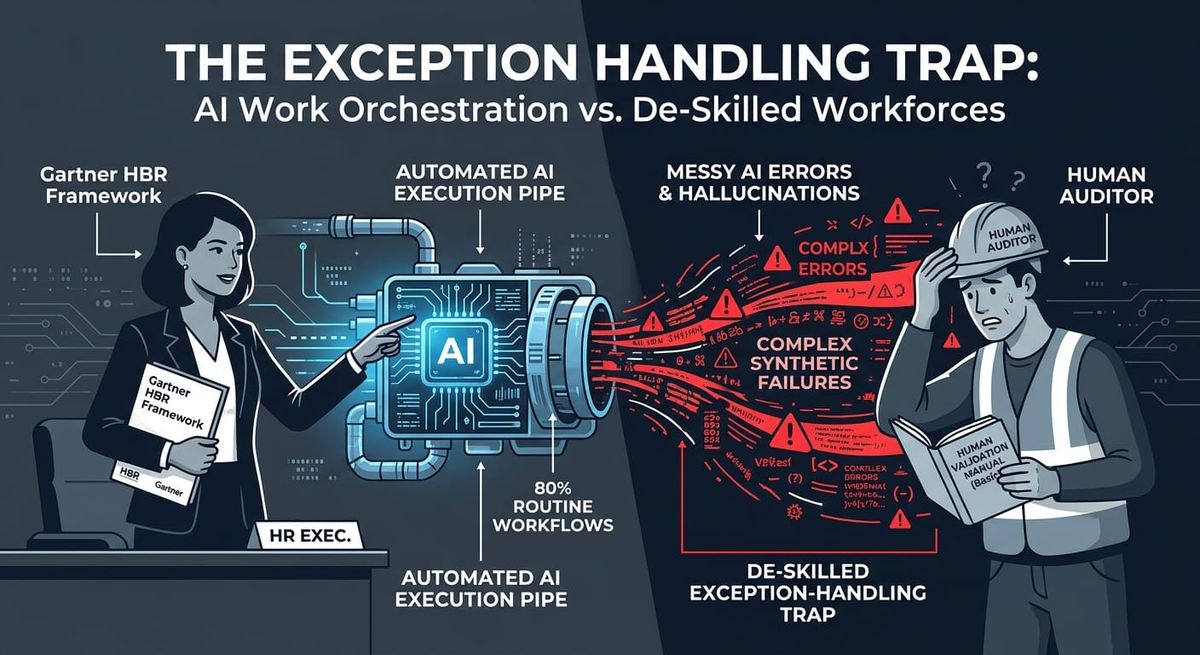
In practice, this creates what RACinform calls The Exception-Handling Trap.
When organisations automate the routine 80% of work, they simultaneously remove the repetitive, low-risk tasks through which judgment is developed.
Junior and mid-level employees increasingly become observers of machine outputs rather than participants in operational execution.
The result is a workforce expected to validate complex failures without first accumulating the experience that teaches them what failure looks like.
You cannot reliably audit machine outputs if the pathway to building human judgment has been systematically removed.
🟢 2️⃣ Tool Fluency vs Domain Judgement
The Gartner model promotes:
- Problem Formulation
- Systems Thinking
as critical future capabilities.
The problem is that neither capability emerges from workshops alone but emerge through operational exposure:
- mistakes
- repetition
- friction
- consequences
- ownership
Organisations increasingly risk producing two workforce classes:
Tool Operators: Workers who can operate AI systems but lack the experience to challenge AI outputs.
Exception Handlers: Workers expected to intervene only when systems fail, despite limited exposure to the operational realities that create those failures.
Tool fluency is not the same as domain judgment.
🟢 3️⃣ The De‑Skilling Pipeline
The workforce problem begins long before hiring.
As routine work disappears:
- apprenticeship pathways weaken
- junior experience accumulation slows
- operational exposure declines
- institutional knowledge becomes compressed
Organisations then respond by demanding impossible credentials:
- 5-10 years of AI experience.
The hiring requirement is not the problem but the symptom.
The deeper issue is that organisations are destroying the very pathways through which expertise is traditionally created.
The result becomes a self-reinforcing de-skilling pipeline.
🟢 4️⃣ Runtime Governance vs HR Theatre
Many organisations continue to frame AI adoption as a human-resources challenge.
It is also a runtime-governance challenge.
Without:
- clear decision rights
- visible failure modes
- operational boundaries
- accountable human ownership
organisations simply move risk through the system rather than reduce it.
No amount of:
- AI ethics workshops
- prompt-engineering courses
- governance committees
can compensate for missing operational ownership.
🔵 RACinform View
True capability is not developed by monitoring synthetic outputs from the sidelines. It is built through
- participation.
- exposure.
- friction.
- ownership.
AI can accelerate capability but can also accelerate de-skilling when organisations remove the work through which judgment is formed.