Apprenticeship Erasure: What The Numbers Are Telling Us
The AI-era jobs discussion often focuses on layoffs.
The deeper signal may be the disappearance of apprenticeship routes.
🟢 Market Snapshot — Oct 2026 - by Sectors
1️⃣ Technology & Information Services
195,000+ technology layoffs globally in 2026.
- Oracle: ~13% workforce reduction.
- Dell: ~10% workforce reduction.
Technical recruiting and sourcing functions continue shrinking.
2️⃣ Operations & Logistics
- UPS: up to 30,000 roles affected through multi-year restructuring.
3️⃣ Administration & Support
- 6.1 million projected reduction in administrative roles.
- 13.7 million projected reduction in customer-support positions.
4️⃣ Banking & Financial Services
- Barclays: 5,000 roles (5% of workforce); approximately 60% support and development functions.
- HSBC: management reductions linked to AI-agent prioritisation.
- Standard Chartered: 15% reduction in corporate functions planned by 2030.
🟢 Market Snapshot by Technology Platforms — Oct 2026
- Microsoft: 60,000 voluntary exits (approximately 25% of workforce) while AI investment continues.
- Meta: 10% workforce reduction (~8,000 roles) while increasing AI infrastructure spending.
- eBay: 9% workforce reduction (~1,000 roles), following an earlier 6% reduction.
- Dropbox: 9% workforce reduction (~200 roles).
- Amazon: approximately 30,000 positions removed across broader restructuring programmes.
🟢 What The Statistics Suggest
These numbers do not describe a temporary slowdown.
They describe a structural re-layering of work.
Capital is moving:
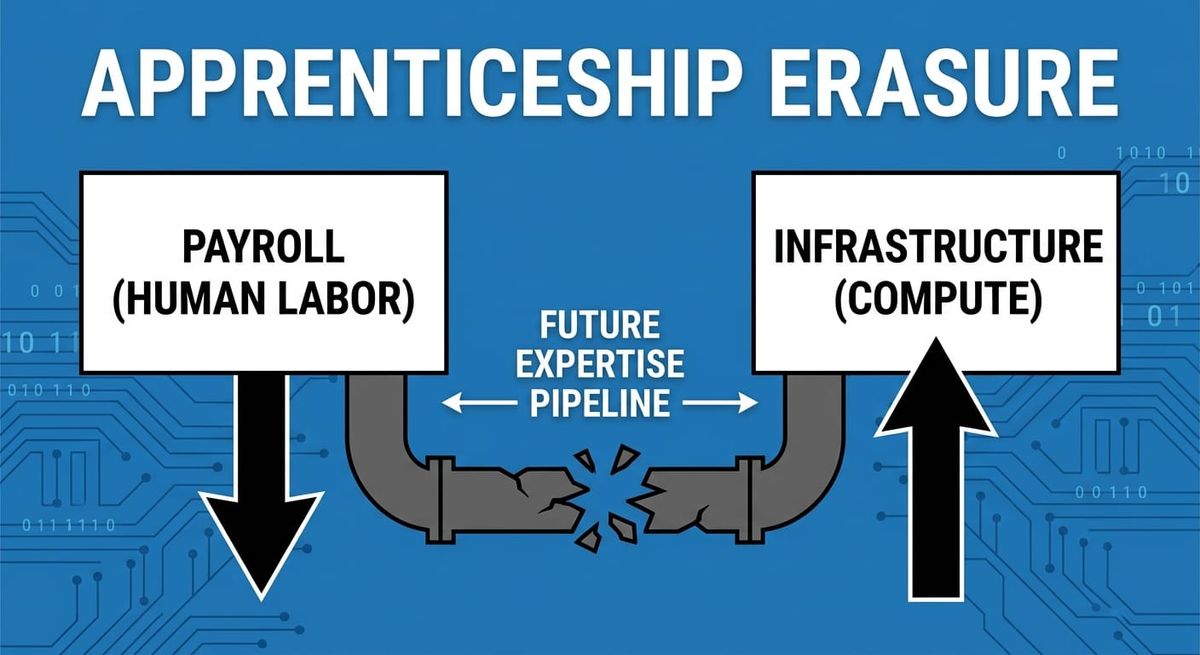
- Payroll ➡️ Infrastructure
- Labour ➡️ Compute
- Routine execution ➡️ Automated systems
🟢 The Apprenticeship Question
Historically, junior roles did two jobs:
- Deliver output.
- Create future expertise.
As routine work disappears, organisations risk losing the environments where future experts traditionally learned.
The question is no longer: "Where did the jobs go?"
The question is: "Where will future expertise come from?"
Related Framework: 👉 The Erosion Of Apprenticeships
Related Framework: 👉The Junior Deskilling Loop
Related Page: 👉What Creates Capable Adults
🔵 RACinform View
The AI-era risk may not be job displacement alone.
It may be apprenticeship displacement.
An organisation can preserve productivity while weakening the pathways that create future judgement, expertise and leadership.
Automation can compress payroll.
It cannot automatically manufacture experience.