
What Creates Capable Adults?
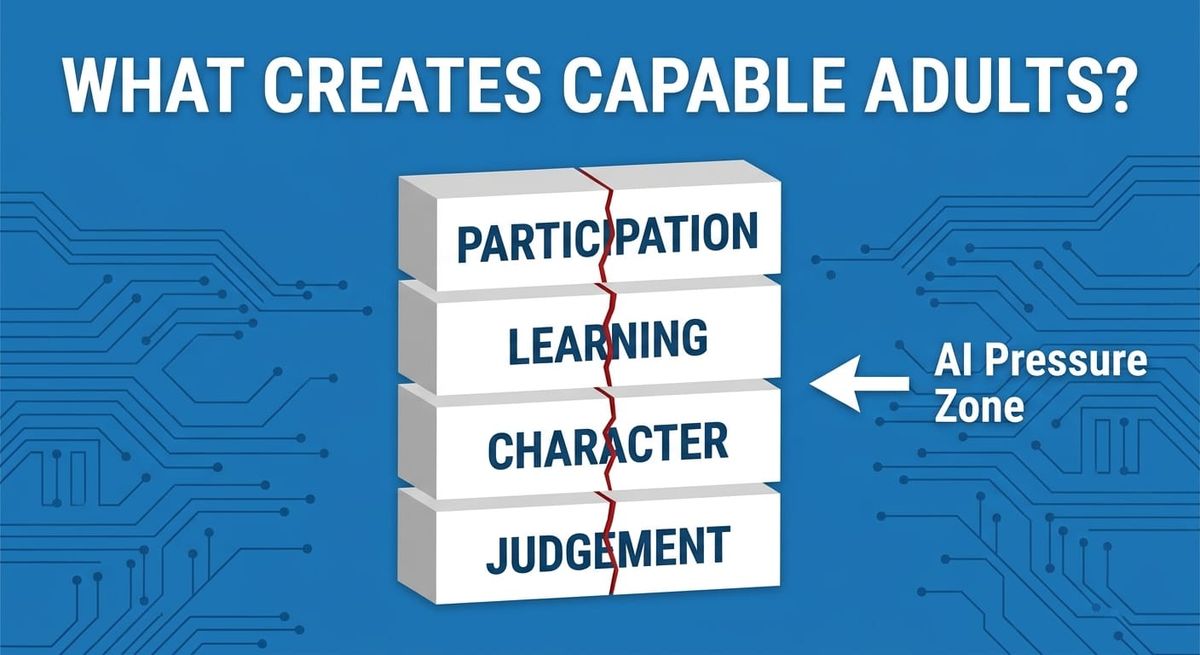
🟢 Conditions to create capable adults
For decades, education, work and society operated on a simple assumption:
- Participation
- Learning
- Character
- Judgement
produced capable adults.
The AI era challenges each stage simultaneously.
The debate is often framed as technology versus people.
The more important question may be:
What conditions are required to create capable adults in the first place?
→ 1️⃣ Participation
Capability begins with participation.
- Children learn by doing.
- Apprentices learn by working.
- Professionals learn by exposure.
- Participation creates experience.
Without participation, there is little opportunity for growth.
👉 Related Observation
AI-assisted learning raises a similar question: Can technology improve learning outcomes, if motivation, participation and discipline remain unchanged?
AI tools can support learning. They cannot force participation.
→2️⃣ Learning
Knowledge remains essential.
Schools, mentors, employers and institutions all contribute to learning.
The challenge is not access to information.
The challenge is absorption.
The AI era has made knowledge abundant.
It has not made learning automatic. Related Framework: 👉 AI Adaptation Safety
Technology can accelerate access. Humans still perform the learning.
→3️⃣ Character
Capability is not solely technical.
Academic success does not automatically produce trustworthy adults.
Character influences:
- Trust
- Reputation
- Responsibility
- Conduct
- Social outcomes
The social-media era made behaviour visible.
The AI era may make behaviour records durable.
Related Observation: 👉 Bullying Records & Admissions
Actions increasingly leave evidence trails that can follow people across institutions and opportunities.
Some recent university admission policies demonstrate that academic achievement alone may not outweigh serious documented behavioural concerns.
→ 4️⃣ Judgement
Judgement is accumulated. It rarely appears suddenly. Historically, judgement emerged through repetition:
Repetition of:
→ Observation
→ Mistakes
→ Correction
→ Experience
→ Judgement
This process is often called apprenticeship.
Related Framework: 👉 Erosion of Apprenticeships
Related Framework: 👉 Junior Deskilling Loop
Related Case Study: 👉 The Exception-Handling Trap
As routine work is automated by organisations, risk of removing the very experiences that traditionally created expert judgement is high.
🟢 The Emerging Risk
Many discussions focus on: AI Capability
The deeper concern may be: Human Capability
A society can create powerful systems while simultaneously weakening the pathways that create capable people.
The challenge is not whether AI becomes more capable.
The challenge is whether humans continue developing the capabilities required to live, work and govern alongside it.
🔵 RACinform View
Capable adults are rarely produced by technology alone.
They emerge through:
- Participation
- Learning
- Character
- Judgement
AI can amplify all four.
AI can also weaken all four.
The governance challenge is ensuring that human development keeps pace with technological capability.
Related Framework:
👉 AI Adaptation Safety
As capability accelerates, societies must ensure that participation, learning, character and judgement continue developing at a pace that allows people to safely absorb technological change.