AI Adaptation Safety
🟢 Can humans catch-up?
AI safety has become a global priority.
- Model safety
- Cyber safety
- Agent safety
- Biosecurity
All matter. But a new question is emerging: Who owns adaptation safety?
- Frontier labs measure capability gains.
- Markets reward faster releases.
- Investors reward acceleration.
Yet human adaptation follows a different curve.
- Workers need time to learn.
- Schools need time to adjust.
- Governments need time to respond.
- Families need time to adapt.
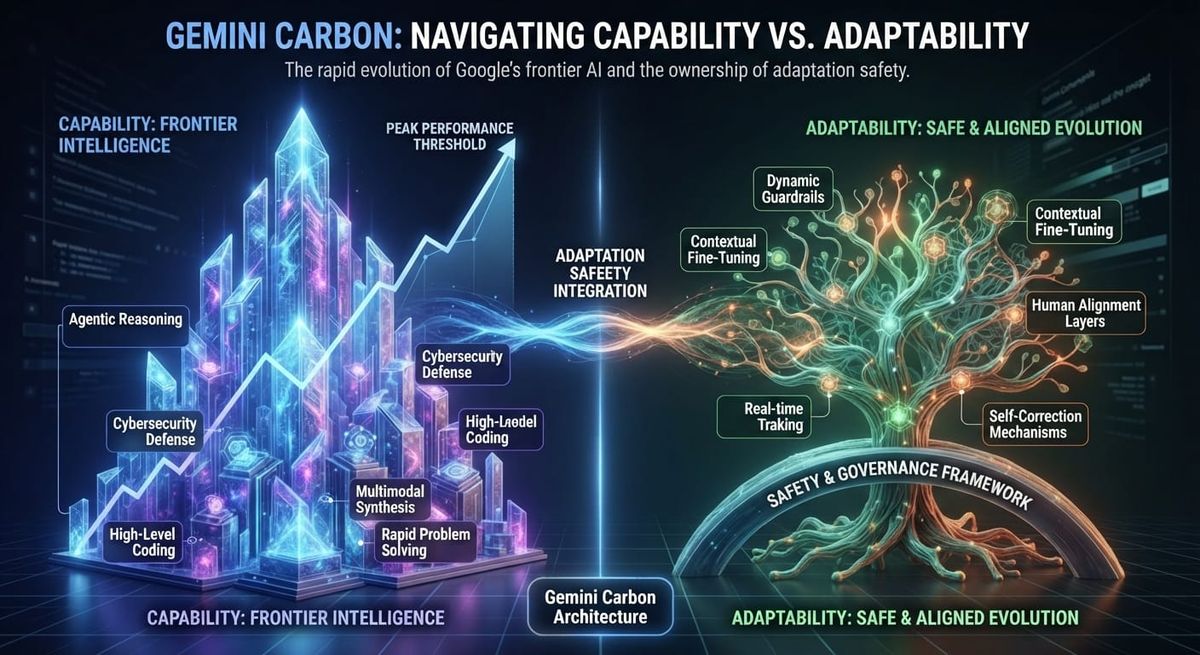
Capability can scale in weeks.
Adaptation often takes years. The result is a widening adaptation gap. This creates:
- Cognitive friction
- Decision fatigue
- Skill displacement
- Governance lag
- Trust erosion
The challenge is no longer whether AI can improve. The challenge is whether society can safely absorb the rate of improvement. Adaptation safety asks a different question: Not "Can we build it?" But: "Can people adapt to it before the next release arrives?" Capability safety protects the system. Adaptation safety protects the people living inside it.
🟢 Google DeepMind & the Gemini model ecosystem
Google DeepMind owns the development and adaptation safety of the Gemini model ecosystem.
Safety frameworks for these frontier models—including Gemini 4 Carbon—are governed by Google's Frontier Safety Framework, which dictates strict alignment, real-time misuse tracking, and guardrails when models reach critical capability thresholds.
🔵 RACinform view
Frontier labs are measuring whether AI can improve.
Adaptation safety asks whether society can absorb the speed of improvement.
The governance challenge is no longer capability alone.
It is closing the gap between capability growth and human adaptation.
- Capability assessment by frontier labs is necessary.
- Capability assessment only by frontier labs is insufficient.
The stronger the capability claim, the stronger the need for independent verification.