Clinical AI: Rollout Optics ≠ Runtime Reality

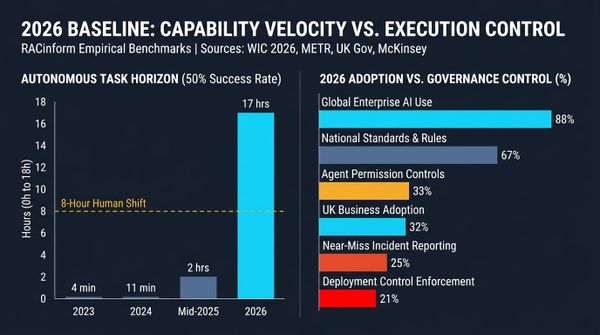
Frontier models are highly capable, but current deployment strategies mistake controlled capability demos for deep operational integration. Tech scales instantly; system physics, workflows, and consequence architecture do not.
🟢 Administrative Productivity Illusion
- Pilot claims of “saved time” (e.g., 43 minutes/day for NHS staff) are executive‑narrative victories.
- In runtime, staff manually audit, correct, and validate AI drafts due to defensive governance and liability pressure.
- Overhead isn’t eliminated; it is shifted to frontline users.
🟢 Jagged Frontier & Performance Choke
- Frontier clinical models (e.g., Med‑Gemini) excel on structured exams but drop sharply on unstructured, cross‑domain queries.
- Advanced pharmacology tasks can fall to ~20% accuracy.
- Polished outputs hide “silent hallucinations” (e.g., invented medical terms), triggering automation bias in time‑poor clinicians.
🟢 EHR Integration Disconnect
- Pilots succeed because research teams monitor standalone dashboards.
- In production, tools outside the core EHR are ignored under pressure; studies show up to 81% of clinicians overlook external systems.
- The intervention window closes before anyone clicks over.
🟢 Rejection Loop & Liability Drift
- Pilots absorb liability via research grants.
- Production rules place 100% legal accountability on clinicians.
- Faced with black‑box logic tied to their registration, clinicians quietly reject the system and revert to manual baselines.
🟢 Balanced View
- Models perform remarkably well at specific tasks (text parsing, structured exams).
- Systems fail because off‑the‑shelf models are dropped into complex human workflows without consequence architecture.
- Real‑time scrutiny is required; academic review cycles lag behind frontier iteration.
🟢 Comparison Matrix
- Pilot: curated data, hand‑held workflows, executive optics
- Runtime: messy data, unsupported users, automation bias, risk‑shifting loops.
🔵 RACinform view
- Clinical AI doesn’t fail at inference; it fails at runtime governance.
- Early claims must be framed as pilots, not proof of sustained operational impact.
- Frontier deployments require consequence architecture before scale, not after.