Beyond Default Passwords: Why Identity & Access (IAM) Fails at the Execution Plane
🟢 Overview
In the aftermath of cross-border supply chain shocks—from European cold storage collapses to municipal water overrides—the standard post-mortem follows a predictable script: blame default credentials, cite missing multi-factor authentication, and issue warnings about basic cyber hygiene.
This narrative is dangerously incomplete, and again consumers are left to pick up the bill via price hikes.
Focusing solely on credential management hides the real vulnerability: an ungoverned execution plane.
While enterprise IT spends millions auditing PCI-DSS environments to protect cardholder data, critical physical infrastructure is connected directly to automated control loops without deterministic runtime circuit-breakers.
🟢1️⃣ The Perimeter Myth (The IAM Blind Spot)
The Perimeter Myth (The IAM Blind Spot) Identity & Access Management (IAM) is designed to answer a single question: Who is allowed in?
Compliance frameworks (PCI-DSS, ISO 27001) build rigorous perimeter security around credential pathways. However, this creates a critical structural blind spot.
- Corporate Compliance Myopia: Large retail CISOs focus up to 90% of their budgets on scope reduction and securing Cardholder Data Environments (CDE). Meanwhile, industrial hardware—such as refrigeration units, HVAC, and building management systems—is frequently relegated to flat store networks or exposed directly to public IPs.
- Installer Reality: Small, independent grocers and local operators lack the dedicated IT resources to manage site-specific credentials, routinely leaving factory logins active on remote interfaces.
- An IAM failure lets an unauthorised actor or drifting agent through the front door. But a perimeter breach should never cause physical destruction.
The fundamental issue isn't just that an unauthorised user logged in; it's that the system unconditionally executed an out-of-bounds command.
🟢2️⃣ Telemetry of the Execution Failure
The systemic gap between authentication and execution is demonstrated across four distinct operational case studies:
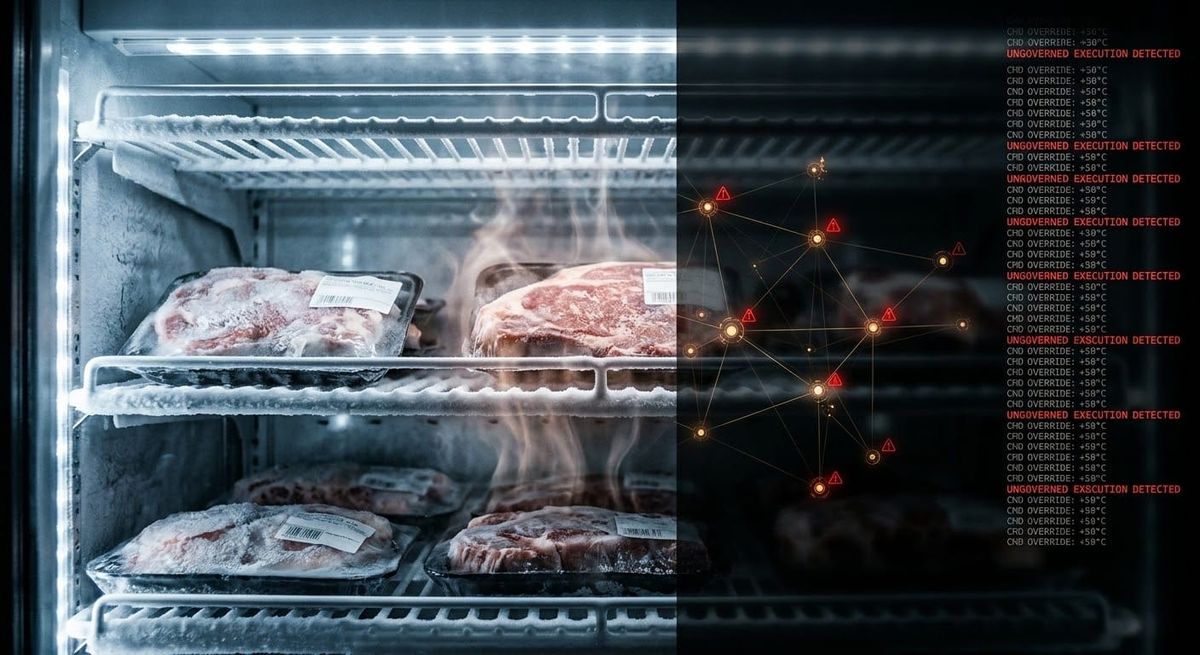
- European Cold Chain Overrides (Danfoss AK-SM / Copeland XWEB): Attackers gained access via exposed web interfaces and default credentials. Once inside, they did not merely shut down the systems; they issued remote commands to set temperatures to +50 °C (+122 °F) overnight across hundreds of stores in France, Sweden, Belgium, and Estonia. The software executed a thermal destruction command without local physical validation.
- Oldsmar Water Treatment Override: Remote access software with shared credentials was breached to alter sodium hydroxide (lye) concentrations from 100 ppm to an extreme 11,100 ppm. The machine layer accepted a toxic chemical instruction without a hardcoded, deterministic threshold check.
- Municipal Water District Hacks (Unitronics PLCs): Threat actors scanned public networks for exposed PLCs using factory-default passwords (
1111), locking out local operators and altering system parameters. Local crews were forced to run pumps manually because the control loop lacked an independent fallback mechanism. - Colonial Pipeline Shutdown: A single compromised password on a legacy VPN account granted access to enterprise billing systems. Out of fear that the IT breach would cross over into physical operations, management proactively shut down the pipeline—demonstrating a lack of isolation between enterprise IAM/IT networks and physical execution planes.
🟢3️⃣ The Need for Runtime Governance (ACW)
Credential leakage, human error, and agentic drift are statistical inevitabilities.
Relying entirely on perimeter IAM leaves physical assets completely unprotected when a boundary is inevitably breached.
Security must move beyond perimeter access control to runtime execution governance.
This requires a structural role sitting directly above the human owner of the system—the Accountability CounterWeight (ACW).
ACW isn't a single person or a simple software patch; it is a 3-pillar control system governing intent, capability, and behaviour under the model of "Governor of AI Owners." Its core job is simple: neutralise human and agentic drift before it becomes machine-scale damage.
Operating through its enforcement pillars on the execution plane, an ACW functions as a deterministic boundary that evaluates actions against physical reality before execution occurs:
- Context-Aware Validation: Even if a command carries valid administrative credentials (whether from a human operator, a compromised key, or an autonomous software agent), the execution layer independently evaluates the intent and safety of the request.
- Deterministic Out-of-Bounds Blocking: A commercial freezer controller must be structurally incapable of executing an instruction to heat a unit to +50 °C, regardless of who or what authorised the login.
- Neutralising Speed Asymmetry: When decisions execute at machine speed (milliseconds), traditional human oversight operates far too slowly to intervene. An independent runtime counterweight halts catastrophic drift before machine-scale damage occurs.
🔵 RACinform view
Stopping systemic supply chain failure requires securing not just who accesses the control panel, but governing what the machine is permitted to execute.
ACW provides the missing model that explains the HOWs of true operational resilience.
For further technical specifications on runtime execution guardrails, explore the ACW Framework and our analysis on Identity & Access Management (IAM) limitations.