AI DC Resilience: The Commissioning Cliff & MRO Governance Gap (UK)
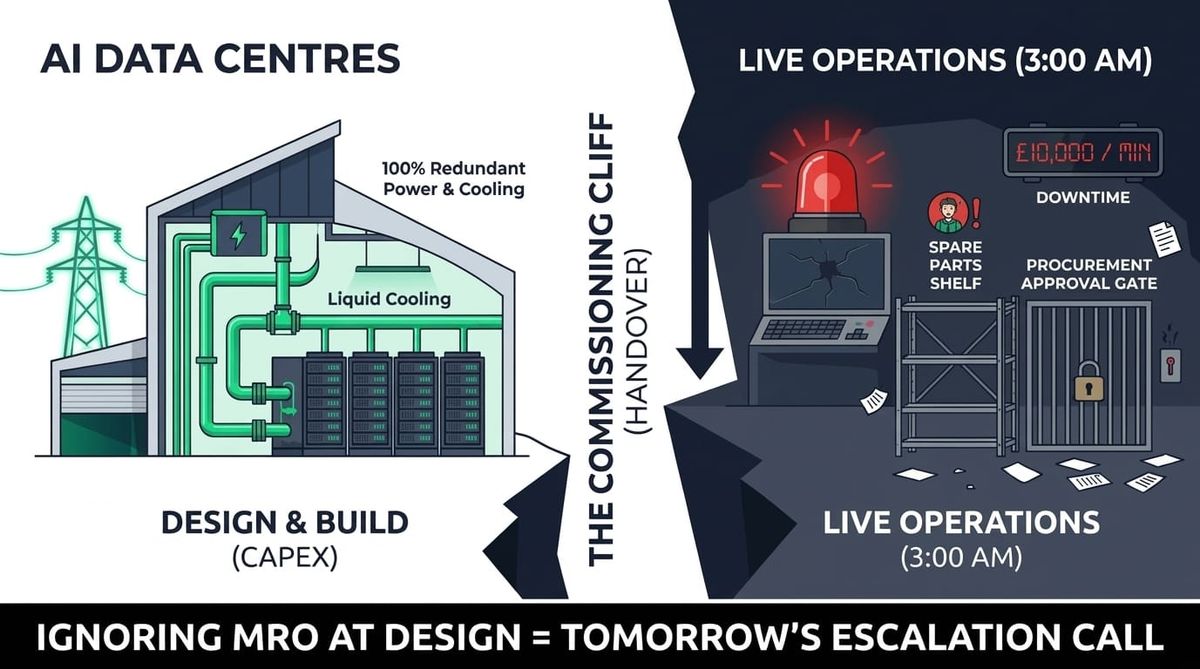
Operators spend billions engineering physical redundancy into AI datacentres—yet run their spare-parts supply chains like an afterthought. At £7,000 to £10,000 per minute in outage losses, unmapped spares and slow procurement approvals are not administrative friction. They are single points of failure.
🟢 Overview
The public debate around AI datacentres obsesses over CapEx velocity: gigawatts secured, GPUs racked, and concrete poured.
The real operational question begins the day after handover:
"When a critical physical component fails at 3:00 AM, how fast can an engineer identify, approve, and fit the exact replacement?"
Drawing on 2026 survey data from RS Group, The Data Centre Alliance (DCA), and The Chartered Institute of Procurement & Supply (CIPS) across UK and Ireland operators, a sharp governance gap emerges. While physical infrastructure is built to Tier III and IV standards, Maintenance, Repair, and Operations (MRO) is routinely treated as low-priority tail spend.
🟢1️⃣ The Commissioning Cliff
Datacentre projects pour massive capital and engineering focus into construction and commissioning. Once live operations begin, responsibility shifts—and supply-chain readiness often drops off a cliff:
- The Strategy Deficit: Only 27% of operators define their MRO supply-chain strategy during the design phase. 20% admit to having no formal strategy at all, and 28% do not know what their approach is.
- The Cost of Delay: Industry benchmarks put datacentre downtime at £7,000 to £10,000 per minute before factoring in SLA penalties, customer compensation, and reputational damage.
- The Baseline Trap: Because MRO planning is rarely embedded in mechanical, engineering, and plumbing (MEP) handover scopes, improvised ordering quietly becomes the permanent operational baseline.
🟢2️⃣ The Procurement vs. Uptime Mismatch
Ask a datacentre operations lead what matters during an active fault, and price never tops the list. Yet corporate buying systems are still configured for routine office consumables:
- What Operations Needs: 82% rank speed of delivery as "very important" and 71% prioritise part availability, while price ranks dead last at 51%. (Under urgent fault conditions, only 8% rank price first.)
- How Systems Actually Buy: MRO sits in indirect "tail spend"—high-volume, low-unit-cost items governed by lowest-cost tendering, unfamiliar portals, and multi-tier sign-off queues.
The resulting failure loop extends Mean Time To Repair (MTTR):
Component Fault ➡ Portal Search Friction ➡ Multi-Tier Sign-Off Queue ➡ SLA Breach & Revenue Loss
Every unnecessary approval step in the purchase-to-pay journey adds direct minutes to the outage clock.
🟢3️⃣ The Discoverability Paradox & Institutional Memory
Even when replacement parts exist in national warehouses, finding the exact specification under pressure stalls recovery:
- The Friction in Finding: 77% of surveyed professionals state that part identification and discovery contributes to restoration delays, with 17% reporting it frequently extends repair windows.
- Fragmented Supplier Bases: Centres use an average of 27 MRO suppliers, yet catalogues are indexed by internal procurement codes rather than equipment criticality or failure mode.
- Tribal Knowledge Risk: Asset registers are often incomplete or trapped inside the memory of individual senior engineers. With 40% of the current UK datacentre workforce expected to retire within the next 15 years, relying on human memory rather than a pre-mapped critical spares register is an acute operational hazard.
🟢4️⃣ The Regional & Edge Blind Spot
Historically, UK datacentre capacity—and its supporting MRO supply hubs—clustered around London and the South East. That geography is shifting fast:
- Distributed Growth: New capacity is expanding into Manchester, Newport, Glasgow, and Ireland, alongside low-latency edge facilities built closer to end users.
- Stranded Supply Chains: 62% of operators report operational exposure because supplier stocking hubs have not followed this regional expansion.
Moving from linear vendor contracts to regional supply webs—combining on-site critical spares with local stocking hubs and tested SLA response times—is now a primary resilience requirement.
🟢5️⃣ Predictive Maintenance Requires Governance First
Roughly 70% of operators agree that predictive maintenance is becoming standard practice. Yet telemetry alone cannot fix a broken supply chain:
- Tools Without Execution: Condition-monitoring sensors can flag bearing wear or thermal drift before an alarm sounds, but value only materialises if asset data is clean, engineers are trained to interpret it, and supplier contracts automatically trigger fulfilment.
- From Reactive to Pre-Mapped: High-performing operators treat critical spares as a capital resilience investment rather than working-capital drag—maintaining an asset-mapped register, pre-qualified 24/7 escalation contacts (named humans, not helpdesk queues), and pre-approved emergency spend pathways.
🔵 RACinform View
Resilience is not proven at ribbon-cutting. It is proven at 3:00 AM during an unplanned fault.
Spending billions on redundant power trains and liquid-cooled AI clusters while leaving spare-parts discovery to emergency portal searches is governance theatre. True operational resilience requires aligning procurement speed, regional stock proximity, and asset-level data before the first rack goes live.
When major datacentre outages make headlines, the root cause rarely begins with the single component that broke. It begins months earlier—in the commissioning cliff left unaddressed at handover.
Related Framework & Reading:
👉 AI DC Waste: The 80:20 Rule of AI Infrastructure
👉 AI DC Waste Heat in 2026: How Countries Are Actually Harvesting Compute Exhaust
👉 The Gartner/HBR Fallacy: Why AI "Work Orchestration" Can't Save De-Skilled Workforces