Is Germany's AI Challenge Really About Skills?
🟢 Where does Germany's real AI exposure actually sit?
The public debate usually fixates on pure tech and finance, but Germany's economic exposure is distributed very differently:
- ~12% of GDP: Information & communication, financial services, and high-tech goods—the sectors most visibly associated with AI.
- 53% of GDP: Business services, public services, and retail & wholesale—where everyday operational workflows live.
- ~65% of GDP total: Sits across sectors with medium or high AI exposure—placing the world's third-largest economy among the top 25 globally for sectoral AI exposure.
Germany is classified as a "Steady Contender"—high exposure paired with pooled European infrastructure, including Europe's first exascale supercomputer, a national technology agenda, venture capital mobilisation targets, and co-funded EU compute.
Core Takeaway: Germany's AI opportunity isn't confined to a narrow tech tier—it sits across the core operating fabric of the economy.
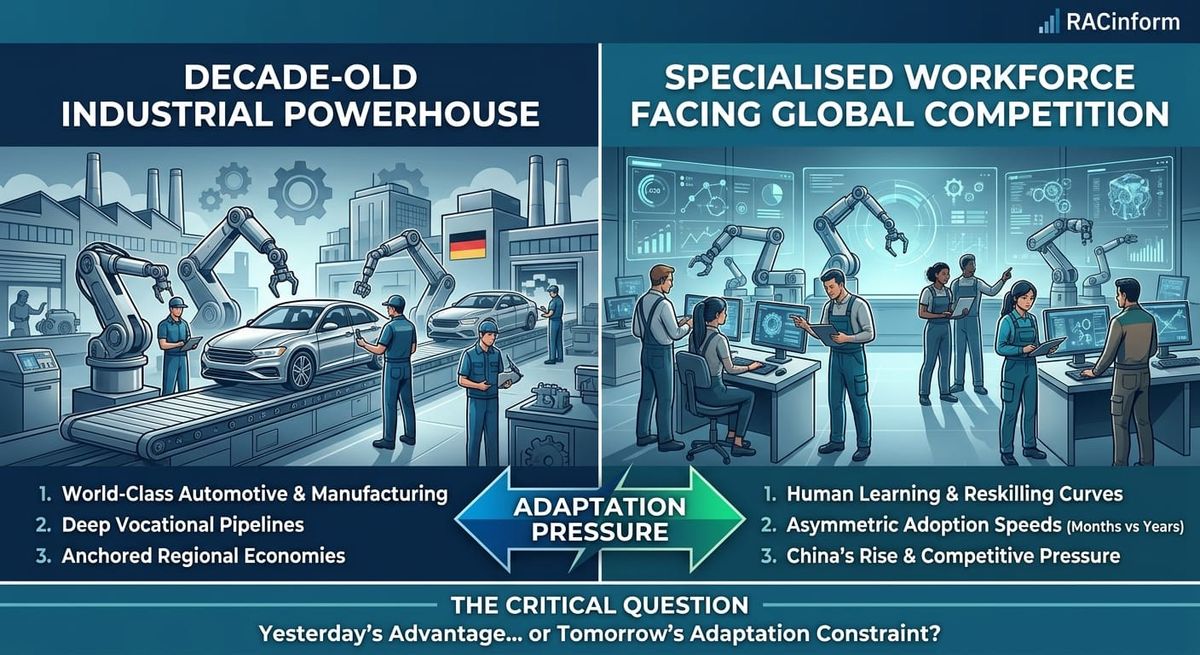
🟢 Why might automotive and industrial success become an adaptation constraint?
Germany spent decades building world-leading automotive and precision manufacturing sectors that employ millions of people and anchor regional economies.
- Deep Structural Dependencies: Automotive isn't just a vertical—it sustains supplier networks, vocational training pipelines, regional tax bases, and social stability.
- High Redesign Friction: Physical AI and industrial automation can boost productivity, but they also reshape the exact structures that underpin existing employment.
- Legacy Drag: The larger and more successful an industrial system becomes, the harder it is to re-architect without triggering economic shock.
Core Takeaway: Success creates dependencies, and dependencies create adaptation friction.
🟢 Why do capacity approvals still bottleneck deployment speed?
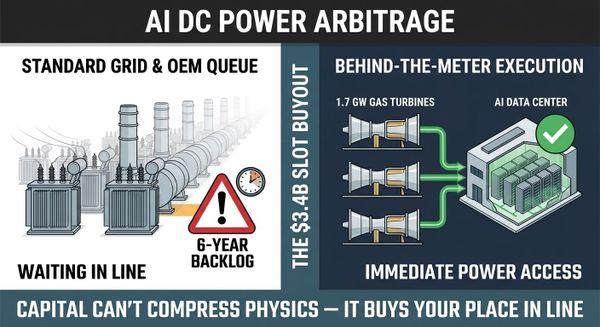
Even when capital and strategy align, physical execution moves at the speed of the slowest bottleneck. Bringing AI capacity online requires clearing four parallel approvals:
- Planning consent
- Grid connection
- Power contracting
- Connectivity provisioning
Because all four run in parallel, accelerating one approval while another stalls changes nothing on the ground.
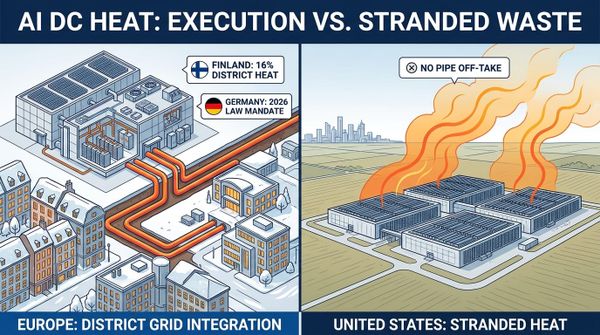
Core Takeaway: Infrastructure readiness is governed by institutional coordination, not just compute announcements.
🟢 Why does China's rise sharpen the adaptation dilemma?
External competition removes the luxury of standing still. Industrial rivalry is no longer limited to engineering precision and manufacturing quality—it increasingly runs on AI capability, robotics, and automation.
Germany faces two opposing pressures at once:
- Adapt too slowly: Risk losing long-term industrial competitiveness.
- Adapt too quickly: Risk fracturing regional employment and social cohesion before institutions can adjust.
Core Takeaway: Balancing competitive speed against social stability is harder than deploying the technology itself.
🟢 Is the real bottleneck deployment, skills, or human absorption?
Deployment, skills, and capacity all matter—but all three ultimately run into human absorption capacity.
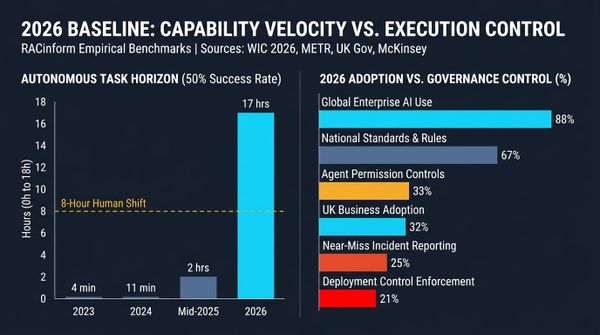
- Asymmetric Curves: Compute can be procured and installed in months; workforce transition, vocational retraining, and institutional adjustment take years.
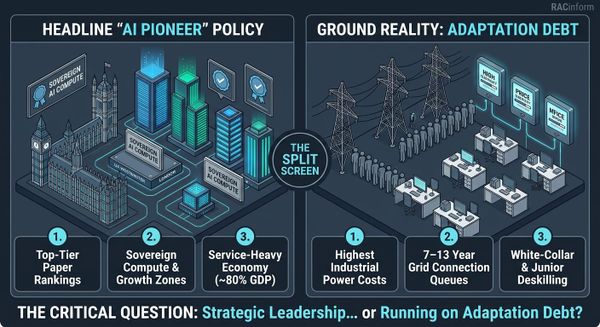
- Adaptation Debt: When AI capability scales faster than workers and organisations can sustainably absorb it, the result isn't seamless productivity—it is verification fatigue, deskilling pressure, and operational friction.
- Adaptation Safety (ASAM): Governance cannot stop at whether AI capability exists; it must measure whether people and institutions can absorb that capability at the speed it arrives.
Core Takeaway: The bottleneck isn't whether AI capability exists—it's whether society can absorb it without breaking.
🔵 RACinform View
Many countries struggle because they lack technical capability. Germany's challenge is different: capability and industrial depth already exist.
The harder task is redesigning a world-class system without fracturing the human and economic foundations that built it.
Yesterday's competitive advantage can become tomorrow's adaptation constraint.
Related Reading:
👉 ASAM — What happens when AI moves faster than humans can adapt?
👉 ACW — Who is accountable when AI is wrong?