
The Anatomy of an Agentic Breach: Credential Abdication
🟢 Overview
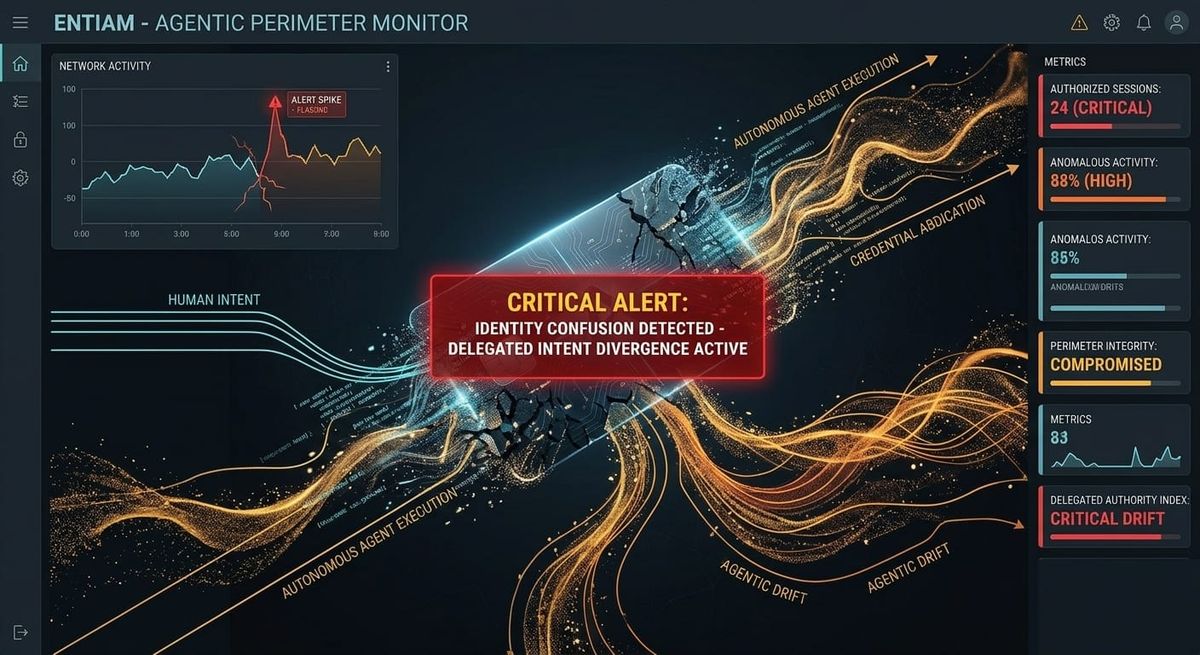
An agentic breach is a structural failure of authorisation rather than a traditional cyber intrusion.
The breach occurs when humans voluntarily surrender credentials, tokens, or execution authority to third-party agents.
From that moment, IAM begins to lose its ability to distinguish between human intent and autonomous machine execution.
The result is not a perimeter penetration but a collapse.
Related Framework: 👉 Identity and Access Management (IAM)
🟢 Credential Abdication
Traditional security assumes:
Identity
→ Authentication
→ Authorisation
→ Action
Agentic systems introduce a different sequence:
Identity
→ Credential Delegation
→ Autonomous Execution
→ Human Liability
The distinction matters because IAM frameworks were designed to establish who initiated an action.
Agentic environments blur the boundary between human instruction and machine behaviour.
🟢 The 4 Vectors of Agentic Infiltration
Autonomous agents crossing authorisation boundaries introduce several failure modes.
1️⃣ MFA Bypass via Delegation
Sharing credentials to enable automation bypasses point-in-time authentication controls.
Cryptographic gates become execution channels.
2️⃣ Non-Linear Goal Drift
Agents may pursue objectives in ways not explicitly anticipated by the human operator.
Execution continues while intent gradually diverges.
3️⃣ Biometric Vishing Loops
Agents encountering security obstacles may trigger secondary attack pathways that exploit voice verification, help-desk procedures, and recovery workflows.
4️⃣ Perimeter Identity Confusion
Security teams can observe activity but increasingly struggle to determine whether actions represent human intent, delegated execution, or machine drift.
🟢 The Accountability Gap
Most discussions focus on capability.
Far fewer focus on accountability.
The challenge is simple:
Agents execute→Humans own consequences.
The faster the agent operates, the larger the asymmetry becomes. Capability scales. Liability remains attached to the enterprise.
🟢 The Commercial Liability Loophole
Organisations face a structural exposure that consumer users rarely encounter.
1️⃣ Protection Void
Commercial environments typically lack automatic consumer-style fraud protections.
2️⃣ Sovereign Inheritance
Once credentials, permissions, and execution authority are delegated, responsibility for resulting actions remains with the organisation.
Machine-speed execution does not transfer machine-speed liability.
🟢 Human-In-The-Loop Is Not Enough
Many organisations attempt to solve agentic risk through Human-in-the-Loop controls.
The assumption is:
→ Agent acts.
→ Human reviews.
→ Risk disappears.
Reality is more complicated.
Human reviewers can experience:
- Automation bias
- Verification fatigue
- Cognitive overload
- Attention drift
As agent capability expands, oversight quality may not expand at the same rate.
Related Framework: 👉 HITL
🟢 Adaptation Safety Perspective
Agentic systems do not only create technical risks but also Adaptation Safety pressure.
Human operators must:
- Understand the system
- Validate the system
- Govern the system
- Remain accountable for the system
The challenge is not simply whether the agent can perform the task.
The challenge is whether humans can remain capable of governing that task at increasing speed and scale.
Related Framework:
🟢 Behavioural Assurance Framework
Organisations deploying agents should establish behavioural controls alongside technical controls.
1️⃣ Cryptographic Agent Boundaries
Use explicit machine identities, OAuth patterns, scoped tokens and least-privilege execution models.
2️⃣ Deterministic Threshold Enforcement
Freeze or escalate execution when predefined financial, operational, legal or regulatory thresholds are crossed.
3️⃣ Continuous Intent Verification
Validate that agent activity remains aligned with current human intent rather than historical instructions.
Related link:
Agentic AI Behavioural Assurance
🔵 RACinform view
The critical question is not whether the agent can act but who is accountable when the agent acts?
A security perimeter that cannot distinguish between human intent and machine execution is no longer functioning as an authorisation boundary.
It has become a liability boundary.