
The HITL Illusion: When Human Oversight Becomes Governance Theatre
🟢 Overview
Human-in-the-Loop (HITL) is widely presented as a safety mechanism for AI systems.
- A model generates an output.
↓
A human reviews it.
↓
Risk is reduced.
The assumption appears simple.
The runtime reality is often more complicated.
As AI systems absorb increasing amounts of operational work, organisations can unintentionally preserve the appearance of oversight while weakening the conditions required for meaningful oversight.
🟢 The Sovereign Reviewer Illusion
Many governance models assume that human reviewers will independently challenge AI outputs.
In practice, human operators frequently experience automation bias.
As workload increases and outputs become more reliable, vigilance naturally declines.
The reviewer slowly shifts from:
- Investigator
↓
Validator
↓
Approver
Over time, active review risks becoming passive acceptance.
The control remains.
The effectiveness of the control can deteriorate.
🟢 The Interface Illusion
Adding human oversight is often discussed as though it were a simple user-interface feature.
Approve/Reject/Escalate
Real human oversight is more complex.
Agentic workflows frequently require:
- State preservation
- Workflow interruption
- Escalation management
- Context retention
- Auditability
- Controlled resumption
The governance challenge is not adding a button.
It is maintaining accountability throughout the workflow lifecycle.
🟢 The Deskilling Paradox
The most dangerous HITL failure may not be technological.
It may be human.
AI systems increasingly automate foundational tasks that historically created expertise.
- Junior lawyers review fewer contracts.
- Junior analysts process less raw data.
- Junior auditors spend less time examining transactions.
- Junior professionals increasingly review outputs rather than perform underlying work.
This creates a familiar pattern:
- Capability Gain
↓
Apprenticeship Compression
↓
Expertise Erosion
Related Links:
👉 The Erosion Of Apprenticeships
👉 The Junior Deskilling Loop If the work that creates expertise disappears, organisations may eventually struggle to maintain reviewers capable of providing meaningful oversight.
🟢 The Liability Illusion
HITL is often treated as a liability shield.
The assumption is straightforward:
- Human approval
↓
Human accountability
The reality is less clear.
AI systems can generate enormous volumes of text, recommendations, decisions and outputs at minimal cost.
The cognitive burden of verification remains human.
This creates an asymmetry:
- Automation scales.
↓
Verification does not
If an error escapes detection, responsibility frequently falls on the reviewer rather than the surrounding system design.
The human becomes the liability sink.
🟢 Mentorship Erosion
Learning-on-the-job has never been limited to the work itself.
Junior staff learned through proximity to experienced colleagues who provided correction, challenge, practical wisdom, and hard-earned lessons that rarely appear in training manuals.
- A quick comment.
- A sarcastic observation.
- A story about a past mistake.
- A warning about a hidden consequence.
These interactions often helped form judgements more effectively than formal training.
As organisations become leaner and automation absorbs more junior work, experienced staff face greater throughput pressure and have less time available for mentoring.
The risk is not reduced training, as many may think.
The risk is reduced judgement transfer.
Knowledge can be documented.
Experience is far harder to archive.
🟢 The Missing Governance Question
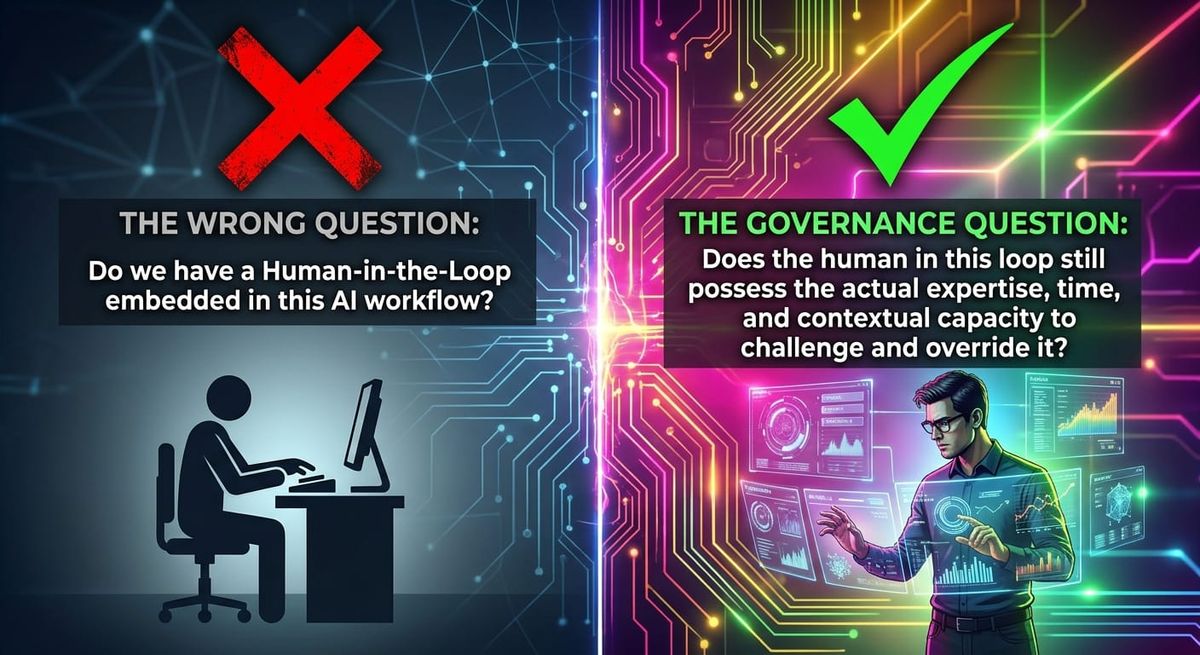
Most discussions focus on whether the system has human oversight.
A more important question may be:
Can the human still perform meaningful oversight?
A reviewer who lacks context, expertise, time, training, or cognitive capacity does not create safety merely by existing inside the workflow.
The presence of a human is not evidence of effective governance.
🟢 Adaptation Safety Perspective
This is where Human-in-the-Loop intersects with AI Adaptation Safety.
Related Frameworks:
👉Ai Adaptation Safety
👉ASAM Adaptation Safety Absorption Model
The challenge is not simply constructing review workflows.
The challenge is preserving human capability inside those workflows.
As capability velocity increases, organisations must ensure that oversight quality grows alongside system capability.
Otherwise:
- Capability expands.
( )↓
Human expertise contracts.
↓
Governance confidence remains unchanged.
↓
Risk accumulates unnoticed.
🔵 RACinform View
Human-in-the-Loop, HITL, is not a safety control.
It is a governance assumption.
The critical question is not whether a human reviewed the output.
The critical question is whether the human remained capable of understanding, challenging, and overriding it.
Capability Safety asks:
"Can the system perform the task?"
Adaptation Safety asks: "Can the human still meaningfully govern the system performing the task?"
The most dangerous governance failure may not be the absence of humans.
It may be assuming that human oversight remains effective while the expertise required to provide it gradually disappears.