
AI DC: Infrastructure, Power & The Silicon-to-Concrete Mismatch
🟢 Overview
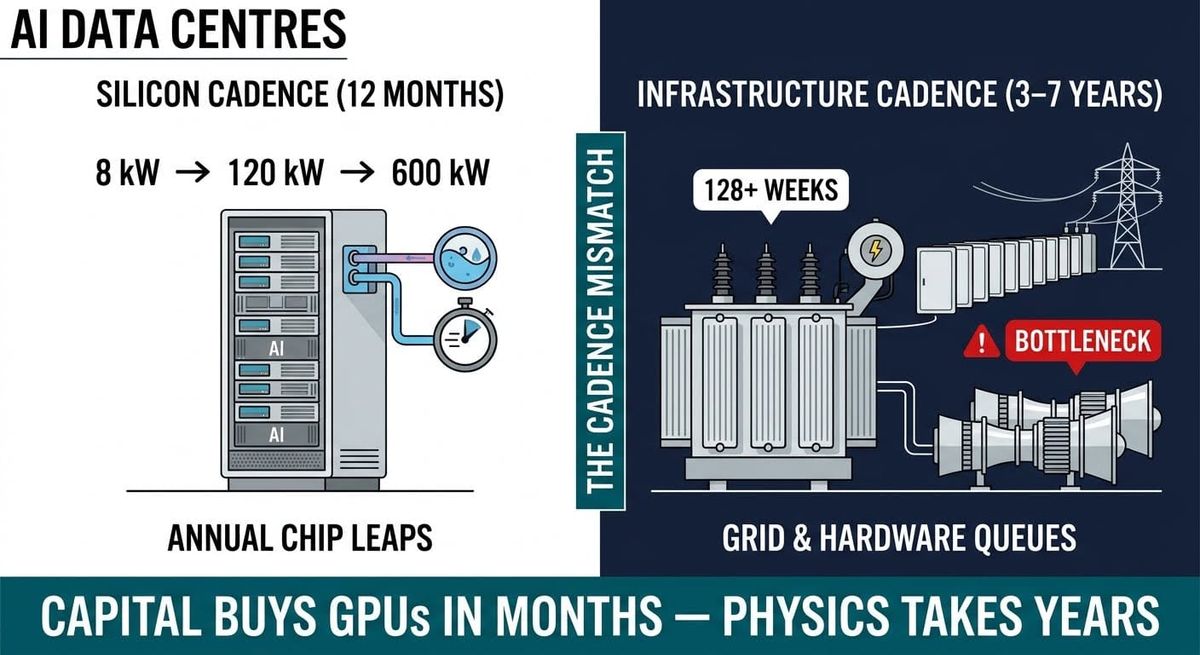
The constraint on AI scale is no longer silicon fabrication—it is civil engineering, high-voltage power, and grid physics. While chip architectures evolve on an annual cycle, transformers, substations, and power plants operate on multi-year timelines. You cannot software-patch a missing substation.
For years, the dominant bottleneck in the AI race was whether foundries could manufacture enough advanced GPUs. Today, the richest technology companies on earth can buy all the silicon they want—yet risk sitting on stranded hardware because they lack "warm shells" with power and cooling ready to switch them on.
The core structural friction is an irreconcilable cadence mismatch:
- Silicon Cadence: ~12 months per rack generation.
- Physical Infrastructure Cadence: 3 to 7 years for grid interconnects, custom transformers, and heavy power generation.
As detailed across industry engineering data and infrastructure analysis, building for AI is no longer an IT procurement exercise. It is a heavy-industry energy and thermodynamic engineering challenge.
🟢1️⃣ The Rack Density & Cadence Trap
Legacy cloud datacentres were built as warehouses of independent cabinets running isolated web and enterprise workloads. Modern AI training halls operate as a single tightly coupled computer, forcing radical jumps in rack power density:
- Legacy Cloud Rack: Under 8 kW per cabinet.
- NVIDIA Blackwell: 120 kW+ per rack (~15x legacy density).
- NVIDIA Vera Rubin: ~200 kW per rack.
- NVIDIA Kyber (2027) & Beyond: 600 kW per rack, scaling toward 1 MW per single cabinet.
The "Obsolete Before Opening" Proof: In 2023, Meta demolished a half-built datacentre in Temple, Texas, because air cooling and legacy networking (which required a 24x to 32x capacity jump for GPU clusters) could not support modern AI loads. Rebuilding it for closed-loop liquid cooling took over four years—only for Texas to freeze new grid connection approvals weeks after the site finally went live.
🟢2️⃣ Thermodynamics & The 800V DC Redesign
Every kilowatt entering a server cabinet exits as heat. Around 30 to 40 kW per rack, air cooling hits a hard physical wall where fan energy alone consumes an unsustainable share of facility power.
Two mandatory architectural shifts follow:
- Direct-to-Chip Liquid Cooling: Cold plates sit directly on GPU silicon, removing fans and hot/cold air aisles in favour of under-floor manifolds, pumps, and leak sensors. However, liquid loops introduce zero-margin operational risk: if cooling pumps fail under full compute load, chips overheat in seconds, requiring redundant pump power and immediate spare-parts readiness.
- 800V Direct Current (DC) Distribution: Pushing 600 kW into one rack at legacy low voltage requires prohibitive amounts of thick copper busbar. Moving to 800V DC steps grid power down once and distributes it at higher voltage—requiring simultaneous electrical and mechanical redesigns on every generational leap.
🟢3️⃣ Heavy Equipment & Grid Queues
Even when hyperscalers overspend on Civil Eng. construction—such as Meta erecting weatherproof fabric structures in Ohio to shave months off concrete build times—progress stalls at the property line:
- Transformer & Switchgear Bottlenecks: Custom high-voltage step-down transformers face average lead times of 128 weeks (~2.5 years), stretching beyond 4 years for the largest units, while unit prices have surged ~80%. Heavy switchgear and circuit breakers sit in the same multi-year queue.
- Grid Saturation: In Northern Virginia, utility requests have approached triple historical peak system delivery, pushing connection waits to 7 years. In Texas (ERCOT), interconnection requests hit 474 GW—more than five times the grid's all-time peak demand—forcing a state audit and connection freeze.
🟢4️⃣ Bypassing the Utility Queue ("Bring Your Own Power")
Unable to wait 3 to 7 years for public utility expansion, major AI operators have shifted from buying grid power to vertically integrating energy generation directly at the campus boundary:
- Behind-the-Meter Generation: Deploying dedicated on-site gas turbines or modular generation to energise compute clusters immediately while awaiting permanent utility interconnects.
- Dedicated Baseload Offtake & Acquisitions: Locking in multi-decade nuclear restarts or acquiring energy and storage developers outright to co-locate power generation beside datacentre halls.
- Dedicated Utility Builds & Ratepayer Friction: Financing multi-gigawatt dedicated power plants through joint ventures—shifting governance debates toward permitting, air quality, and who carries stranded-asset risk if multi-decade power plants outlive AI compute cycles.
Related Reading:
👉AI-DC Power Capital Queue Jumping
🟢5️⃣ The Jevons Paradox of AI Compute Efficiency
A common assumption is that more efficient chips will ease grid pressure. Historical economics—and current deployment data—demonstrate the exact opposite:
Efficiency Per Watt Increases ➡ Compute Cost Drops ➡ Larger Models & 24/7 Agents Deploy ➡ Total Power Demand Climbs
Even though newer architectures like Vera Rubin deliver up to 10x more AI output per megawatt than Blackwell, total cabinet power still rises because vendors pack more compute into every rack. Consequently, the International Energy Agency (IEA) projects global datacentre electricity demand to more than double to ~945 TWh annually by 2030—exceeding the entire electricity consumption of Japan.
🔵 RACinform View
Capital can buy GPUs in months. Capital cannot compress transformer manufacturing, grid permitting, or physics.
The AI infrastructure race has shifted from software velocity to industrial execution. Operators that treat power generation, 800V electrical distribution, liquid-cooling redundancy, and downstream thermal recovery as unified systems will deploy capacity. Those still designing facilities around legacy cloud assumptions risk building stranded concrete shells before their first rack arrives.
Related Framework & Reading:
👉 AI DC Resilience: The Commissioning Cliff & MRO Governance Gap
👉 AI DC Waste: The 80:20 Rule of AI Infrastructure
👉 AI DC Waste Heat in 2026: How Countries Are Actually Harvesting Compute Exhaust