
Social Care: System Physics & Runtime Friction
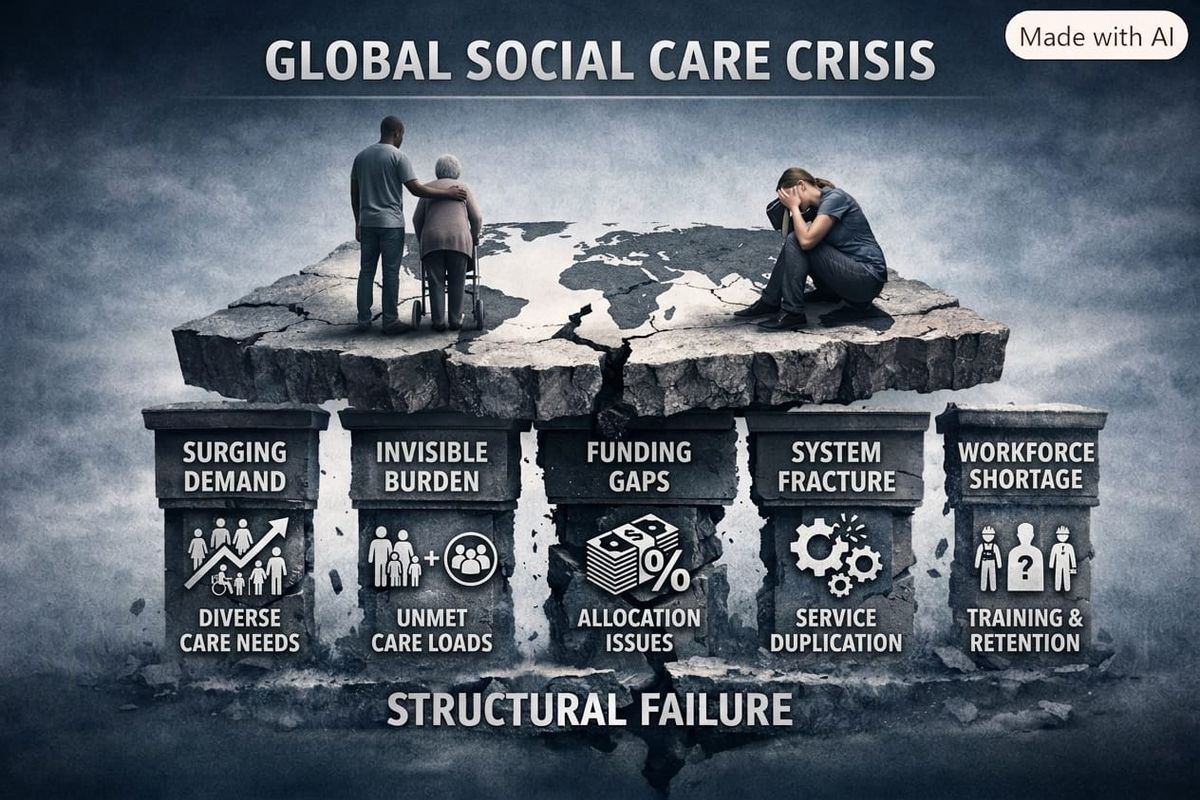
🟢 System Physics & Labour Scarcity
- Demographic & systemic demand
Surging load across elderly demographics, adult working-age disability, and children's services is structurally outpacing the available care workforce. - The UK capacity bottleneck
High systemic case load collides with low domestic recruitment and political immigration friction, choking the primary labor pipeline. - Chronological compression
Whether in home visits, supported living, or residential units, carers face severe time starvation; task saturation is a systemic baseline. - Short-path mechanics
Systemic load, not human malice, drives operational shortcuts. Under pressure, human operators naturally default to the shortest visible path.
🟢 Automation & The Governance Gap
- Compliance documentation trap
AI deployment amplifies existing cracks. In high-pressure workflows, text models simply become the lowest-friction way to fabricate box-ticking care notes and administrative metrics. - Robotic labour gaps
Automated systems and robotics will be deployed out of absolute demographic and labor necessity to fill physical deficits, never emotional voids. - Algorithmic minimisation
AI executes literal optimisation paths. Without hard runtime boundaries, automated tools will prioritise raw incentive targets over complex human ethics. - Idealised workflow delusion
Policy assumes ideal behavior across complex physical, mental health, and disability care settings, ignoring high-stress runtime realities.
🔵 RACinform view
Social care cannot be stabilised by technology. It is a system of humans under load, bounded by immutable resource constraints across disability, mental health, and age care.
AI and robotics will not fix organisational failure; they will simply accelerate existing cracks. Until baseline incentives and high-friction guardrails are rebuilt from reality, advanced tech will only widen the operational gap.