Legal Ai Ops — Runtime Reality
The Ghost in the Billable Hour
Law firms are rushing to deploy AI agents to solve an efficiency problem they don't actually have. The legal sector does not lack cognitive capacity—it lacks a framework for machine accountability. As autonomous workflows move from sandbox demos to live execution, firms are discovering that the true cost of legal AI isn't the software license; it's the unquantifiable risk of runtime reality.
🟢 Overview
The AI debate focuses on capability gains.
The deeper issue is the emergence of systemic constraints that reshape labour, knowledge ownership, and workforce development.
- Workload compression
- Narrative sovereignty drift
- Junior deskilling loop
🟢 Operational friction points
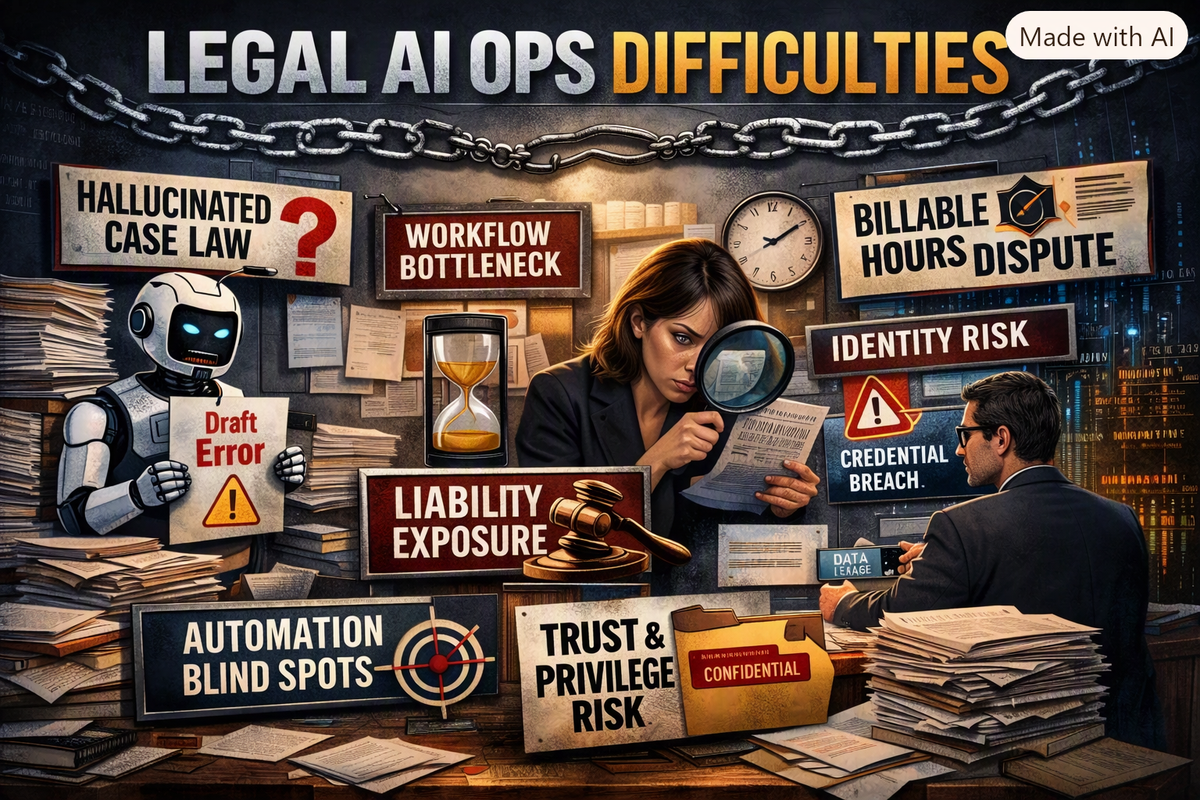
- Verification bottlenecks. The time saved generating text is lost verifying it. Partners are forced to choose between slower delivery or skipping the line-by-line validation required to protect the firm from malpractice.
- Hallucination rate ~17–33% (Stanford 2024)
Even with advanced RAG, underlying models still invent logic, cite fake precedents, or miss subtle context. Relying on raw outputs without runtime filtering introduces catastrophic errors into legal workflows. - Credential abdication
Firms risk turning highly qualified lawyers into passive reviewers who sign off on machine-generated work they do not fully comprehend, shifting accountability from human expertise to a black box. - Billable asset collapse As automation compresses the hours required for drafting and document review, traditional law firms face a structural revenue crisis unless they rapidly pivot away from the billable hour toward value-based pricing models.
🟢 Neutral sector stats (2026)
- 74% weekly AI use (Thomson Reuters)
- 69% individual adoption (8am Legal Report)
- 79% professional adoption (Clio)
- 52% corporate legal adoption (ACC/Everlaw)
- 22% of lawyer job automatable (McKinsey). RACinform: The billable hour isn't collapsing yet—it's just shifting.
🟢Governance gap (agentic systems)
- Authority vs behaviour
Firms can grant an AI agent the authority to perform a task, but they cannot structurally control its behaviour across edge cases. The mismatch between intent and execution creates unmanaged operational risk. - Agentic workflow risk
Multi-step AI workflows that loop, invoke tools, and dynamically chain tasks together often create unpredictable cascading failures, making it impossible to audit where a process went wrong. - Rice's theorem
A mathematical reality proving that you cannot write a program to guarantee the non-trivial properties of another program. In legal terms: no vendor can promise their AI will always act safely, because runtime behaviour is algorithmically unpredictable.
🟢 Runtime guardrails
- High-friction checkpoints
Mandatory, hardcoded "circuit breakers" embedded in the workflow where an AI cannot proceed without explicit, logged human validation. These are not passive "OK" buttons; they are granular sign-offs on specific logic trees, preventing autonomous errors from compounding. - Data sovereignty air-gaps
Strict programmatic boundaries that ensure client data is processed within isolated environments. No data leaks into public frontier models, and zero telemetry or prompting history is repurposed for vendor training loops.
🔵 RACinform view
The legal sector does not face an intelligence problem. It faces an accountability problem.
The moment lawyers cannot reliably distinguish between human judgement, AI generation, and agentic action, the evidential chain begins to weaken.
When a rogue agentic workflow introduces a flawed clause into a multi-million dollar contract, who carries the liability? The law firm will blame the software vendor. The vendor will point to their Terms of Service, which pass all risk back to the user. The insurance providers will hesitate to cover malpractice claims driven by unverified machine outputs.
The future question is not: Can AI do legal work? The future question is: Who carries liability when nobody can explain how the work was produced?