
Knowledge Governance
🟢 Overview
Knowledge governance determines whether an organisation’s knowledge systems create capability or risk.
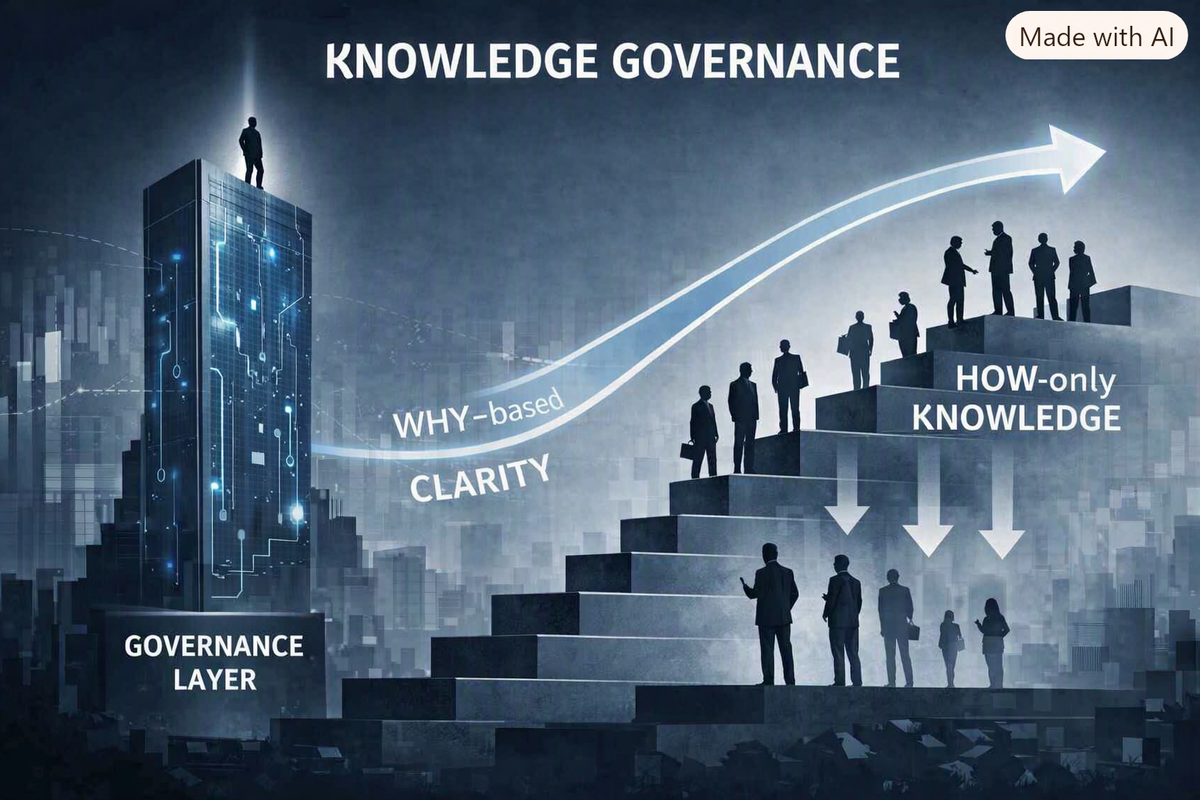
In high‑stakes environments — such as a company servicing 1.4 million+ elevators — HOW‑only answers, for field engineers, accelerate action, but WHY‑based answers create durable, safe, and governed operations. This page outlines the RACinform view on knowledge governance: why context matters, how exposure scales, and what organisations must do to prevent shallow knowledge from becoming systemic failure.
🟢 The Problem: HOW Without WHY
Most enterprise knowledge bases optimise for:
- fast retrieval
- step‑based instructions
- surface‑level fixes
But they rarely provide:
- WHY the step is correct
- WHEN the step is unsafe
- WHAT the caveats are
- WHO owns the decision logic
- WHERE the boundaries apply
Without WHY, technicians execute actions without understanding:
- failure modes
- exceptions
- environmental constraints
- risk conditions
This is not a documentation issue — it is a governance gap.
🟢 Exposure Surface: Why Scale Changes Everything
A global operator services 1.4 million lifts. At this scale:
- A misunderstood HOW affects one technician.
- A misunderstood HOW in a global KB affects thousands.
- A misunderstood HOW in a KB serving 1.4 million lifts affects entire cities.
Knowledge systems become risk multipliers when they lack:
- context
- caveats
- decision logic
- boundary conditions
In safety‑critical systems, HOW‑only knowledge is dangerous.
🟢 WHY Answers Create Durable Capability
WHY answers:
- reveal constraint
- expose caveats
- prevent misdiagnosis
- build technician judgement
- reduce systemic risk
- create organisational memory
WHY transforms knowledge from:
- steps → understanding
- fixes → capability
- retrieval → governance
This is the foundation of consequence architecture.
🟢 Governance Truth: Structure > Speed
Digitising decades of field knowledge is not enough. If the knowledge is:
- shallow
- step‑based
- missing caveats
- missing decision logic
- missing WHY
then the organisation has created a faster way to spread errors. Knowledge systems must be treated as safety infrastructure, not search tools.
🟢 Principles for Knowledge Governance
- HOW answers help technicians.
- WHY answers protect organisations.
- Caveats prevent accidents.
- Boundaries prevent drift.
- Structure prevents systemic failure.
- Governance prevents silent risk.
In the instant‑search age:
- speed matters ✔️
- structure matters more ✔️
- governance matters most 💯
🟢 Key Takeaways
Knowledge governance is a safety function. HOW‑only answers scale risk across millions of units. WHY‑based knowledge creates durable capability. Organisations must embed context, caveats, and decision logic.
Digitisation without governance amplifies exposure.
🟢 Practice Q&A
Q Why is HOW‑only knowledge insufficient in safety‑critical systems?
A Because HOW without context, constraints, and failure modes creates blind execution.
Q How does scale amplify the consequences of shallow knowledge?
A Because every shallow answer becomes a system‑wide multiplier, propagating errors across thousands or millions of units.
Q What role does WHY play in technician judgement?
A WHY provides the reasoning layer — the boundaries, caveats, and decision logic that prevent misdiagnosis and unsafe actions.
Q Why is knowledge governance more important than retrieval speed?
A Because speed without structure creates brittle operations; governance creates safe operations.
Q How can organisations reduce systemic risk in their knowledge bases?
A By embedding WHY, caveats, constraints, and governance into every answer, not just the steps.
🔵 RACinform view
Knowledge Governance is the difference between fast fixes and safe systems. In the AI era, where retrieval is instant and scale is global, organisations must ensure their knowledge bases deliver not just HOW to act — but WHY the action is correct. Knowledge is no longer documentation. It is infrastructure.