
Elderly Care Insurance
🟢 Overview
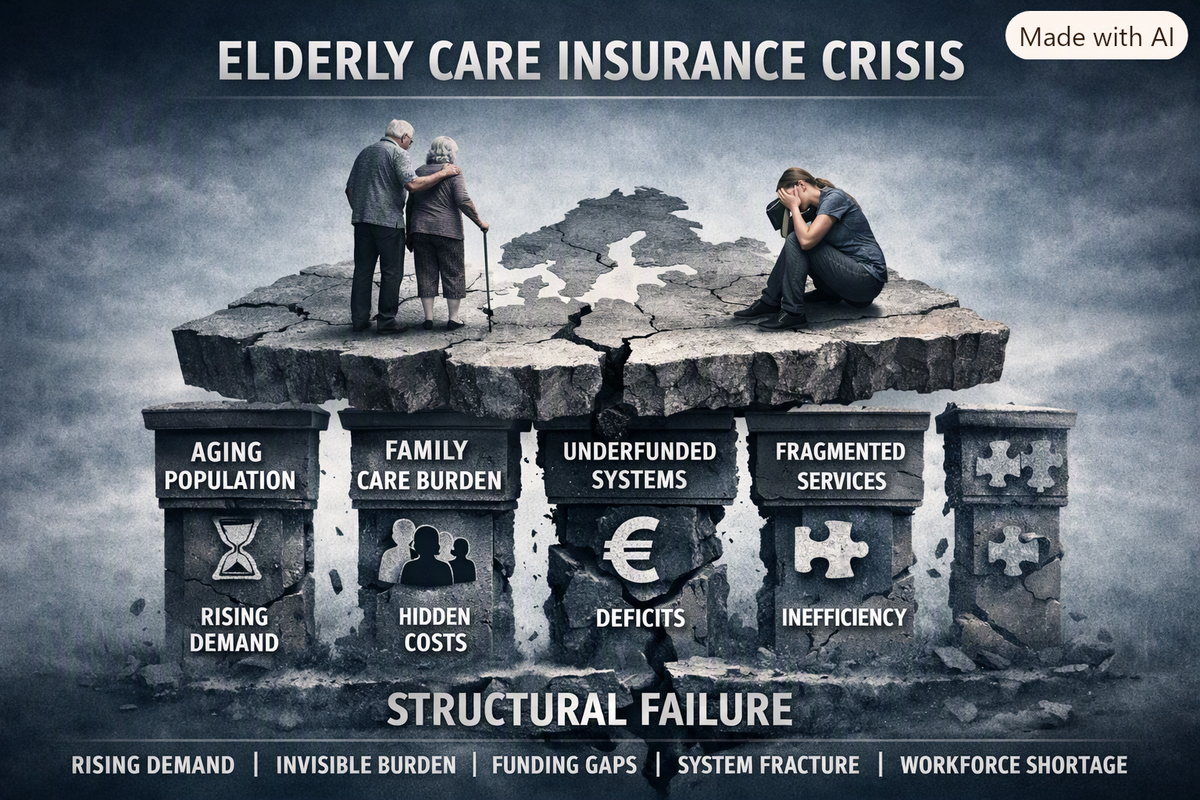
- Europe’s demographic curve is now a structural force: aging populations, shrinking workforces, rising dependency ratios.
- Elderly care insurance is not a funding issue — it is a governance issue: unclear needs, fragmented systems, invisible subsidies, late intervention.
🟢 Core issues
- Long‑term care insurance across Europe is structurally underfunded.
- Germany calls it a “deep crisis.”
- The UK is signalling a National Care Service.
- France, Italy, Spain, Netherlands show the same pattern.
The common thread: rising costs, rising burden, rising fragmentation.
🟢 Needs vs Levels
- A care level does not describe what a person actually needs.
- It only regulates access to limited benefits.
Needs‑based care requires systematic assessment, not classification thresholds.
🟢 Invisible subsidy
Family caregivers are the hidden backbone of elderly care.
- Their labour is unpaid, uncounted, structurally assumed.
- Lost income, lost pensions, health deterioration, reduced autonomy — none of this appears in insurance balance sheets.
🟢 Underfunding
Current models cover only a portion of costs.
- Out‑of‑pocket expenses rising across the EU.
- New revenue alone cannot fix structural deficits.
The question is not “how to fund the system,” but what system is being funded.
🟢 Fragmentation
- Germany: multiple social security codes.
- UK: NHS vs local authority care.
- France: health vs dependency insurance.
- Italy/Spain: regional autonomy.
Fragmentation blocks prevention, coordination, consistent care.
🟢 Missing prevention
- Systems intervene too late — only after formal care‑level rating.
- Prevention requires community health nurses, early risk detection, interprofessional teams, and health literacy support.
Current insurance structures do not fund early intervention.
🟢 Workforce pressure
- Elderly care demand rising.
- Workforce shrinking.
- Recruitment and retention declining.
Insurance reform without workforce reform is cosmetic.
🟢 UK signal
- National Care Service = unified, needs‑based model.
- Recognition that fragmentation + underfunding cannot support aging population.
🟢 Germany signal
- Long‑term care structure commission = explicit crisis acknowledgement.
- Needs‑based care, family‑care burden, prevention, system consolidation.
🟢 Europe’s shared reality
- Rising demand
- Invisible burden
- Funding gaps
- System fracture
- Workforce shortage
Europe is not facing a future problem — it is facing acurrent structural failure.
🔵 RACinform view
Elderly care insurance is a governance topic.
- Needs must be assessed systematically.
- Family‑care burden must be recognised.
- Prevention must be funded early.
- Fragmented systems must be consolidated.
Insurance must reflect demographic reality, not historical design.