Why Content Credentials and the Information Layer Fail at the Execution Plane?
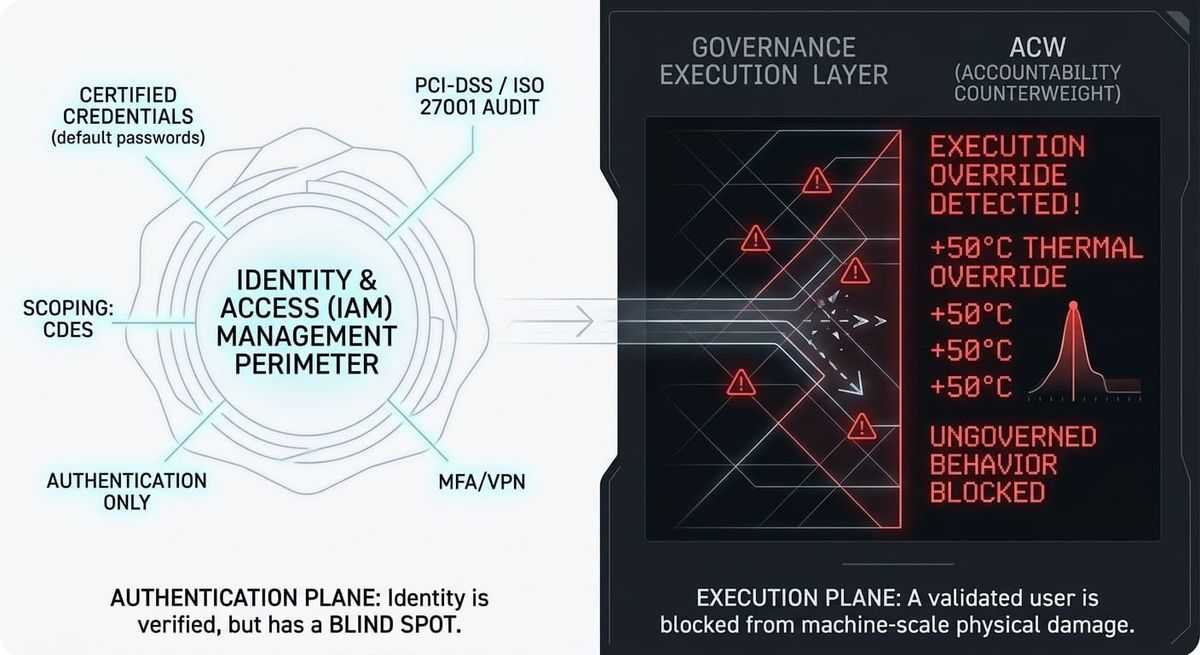
Digital signatures and content credentials get public institutions past the information-verification perimeter, but ungoverned execution planes let compromised actors turn verified media into real-world chaos. Why security governance must sit directly on the control layer.
🟢 Overview
In the wake of the UK Government Communications Service (GCS) trial adoption of Adobe’s Content Credentials—joining global initiatives to stamp out deepfakes and verify digital media provenance—the official narrative follows a familiar, self-congratulatory script: deploy cryptographic "digital nutrition labels," educate the public, and secure the information layer.
This narrative is dangerously incomplete, leaving the public exposed to physical shocks while leaders celebrate file-level transparency.
Focusing solely on content provenance hides the real vulnerability: an ungoverned execution plane.
While tech giants and public sector bodies spend millions watermarking images/text and verifying who generated a press release, critical physical infrastructure is connected directly to automated control loops without deterministic runtime circuit-breakers.
🟢1️⃣ The Provenance Myth (The Information Layer Blind Spot)
Content Credentials and C2PA standards are designed to answer a single question: Who created or modified this file? Compliance and trust frameworks build rigorous cryptographic provenance around digital media and documents. However, this creates a critical structural blind spot.
- Corporate & State Myopia: Public sector communications teams focus 100% of their digital trust budgets on media verification, deepfake detection, and cryptographic watermarking. Meanwhile, industrial hardware—such as refrigeration units, municipal water treatment valves, and building management systems—is left naked to remote script overrides.
- The Signature Fallacy: A verified digital signature proves that a government official or a certified model generated a file. But provenance does not equal permission to execute physical state changes.
- A cryptographic badge lets an authenticated actor or a manipulated agent through the front door.
The fundamental issue isn't just whether a deepfake video of a politician is watermarked; it is that an automated system will unconditionally execute an out-of-bounds command based on a signed instruction.
🟢2️⃣ Telemetry of the Execution Failure
The systemic gap between file-level provenance and physical execution is demonstrated across modern digital trust initiatives:
- The Deepfake vs. Cold Chain Divide: Governments trial Content Credentials to stop readers from being misled by a manipulated video. Simultaneously, a compromised IoT credential overrides a cold storage compressor to +50 °C, spoiling tons of food overnight across commercial supply chains. The information layer is pristine; the physical execution layer is destroyed.
- Watermarking the Press Release: Public bodies mandate C2PA tags for agency announcements while industrial control systems (PLCs) running on default manufacturer settings remain exposed to public web scans. Proving who authored a PDF does not stop a threat actor from dumping toxic lye levels into a water supply.
- The Illusion of Control: Trust seals provide citizens with psychological comfort regarding media authenticity, leaving the operational control loop entirely ungoverned against machine-speed drift or automated agentic errors.
🟢3️⃣ The Need for Runtime Governance (ACW)
Stopping systemic infrastructure failure requires securing not just who authenticated the file, but governing what the machine is permitted to execute. ACW provides the missing model that explains the HOWs of true operational resilience. More at