AI Capacity Tax: Why Administrative Timekeeping Fails Autonomous Execution
🟢 Overview
Traditional operational frameworks were built for deterministic systems.
- If a process took 10 minutes yesterday and 8 minutes today, productivity improved.
Agentic AI breaks that assumption.
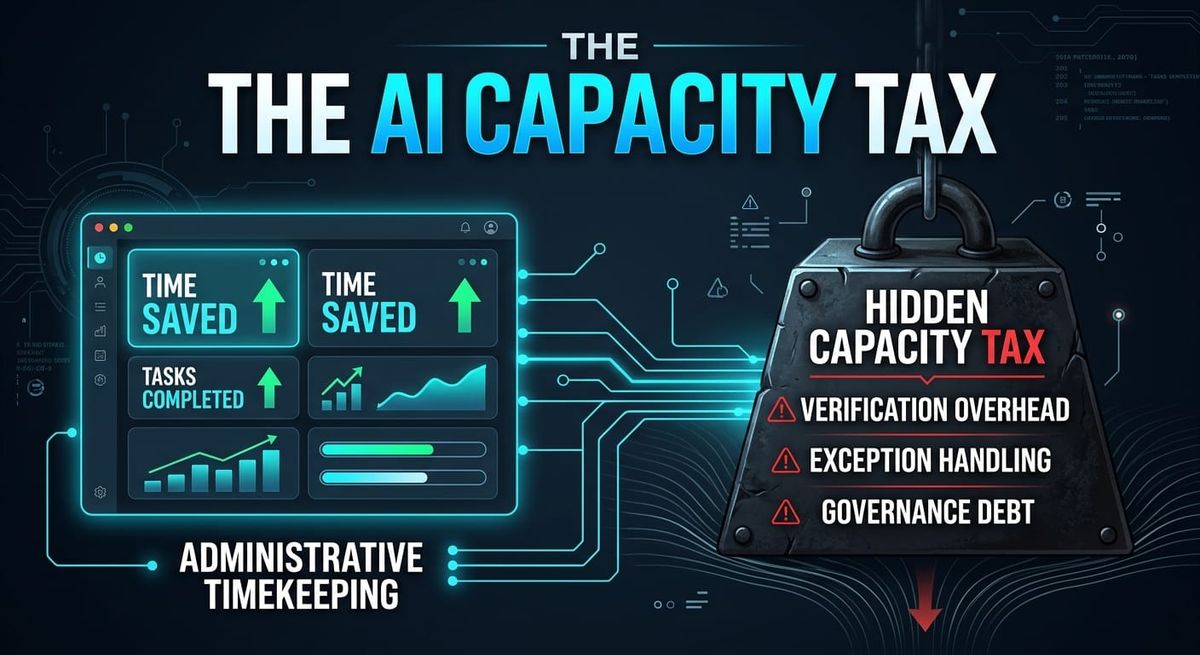
- Modern organisations increasingly measure AI success through saved time, utilisation rates, token costs, licence adoption and workflow acceleration.
The problem is that these metrics often fail to capture verification burden, governance effort, runtime drift and adaptation costs.
As a result, organisations may report productivity gains while simultaneously accumulating hidden operational debt.
🟢 1️⃣ The Baseline Paradox (Phantom Productivity)
Before declaring productivity gains, organisations need a reliable baseline. Most do not have one. Many AI deployments measure:
- Time saved
- Tasks completed
- Volume processed
without first measuring:
- Output quality
- Rework rates
- Exception handling
- Verification effort
The result is phantom productivity.
Organisations believe capacity has increased while quietly shifting additional validation work downstream.
More output does not necessarily mean more value.
Sometimes it simply means more volume requiring later review.
🟢 2️⃣ The Runtime Authority Problem
Administrative reporting works reasonably well for deterministic workflows.
It becomes increasingly unreliable when applied to systems capable of autonomous decision-making.
Runtime environments change continuously.
- Agents adapt.
- Permissions evolve.
- Dependencies shift.
❌The critical question is no longer: "How much work was completed?"
It becomes:
✅"Who had authority to perform the work, under which constraints, and how was that authority governed at runtime?"
Administrative timekeeping cannot answer this question.
Identity, authority, accountability and observability become far more important than hours saved.
🟢 3️⃣ The Workflow Retirement Gap
❌Most organisations focus on:
- AI adoption
- AI governance
- AI training
- AI utilisation
✅Far fewer ask: "Which work should disappear?"
Many deployments simply create:
Old Workflow + AI Workflow + Verification Layer = More Complexity
Workflow redesign creates improvement.
Workflow retirement creates capacity.
Without retiring obsolete activities, organisations risk accumulating adaptation debt while claiming productivity gains.
🟢 4️⃣ The Capacity Tax
The hidden cost of AI frequently appears outside traditional reporting structures.
Examples include:
- Verification effort
- Prompt review
- Exception handling
- Escalation management
- Runtime monitoring
- Governance overhead
- Workforce adaptation
These activities consume human attention even when headline productivity metrics appear positive.
The organisation believes capacity has expanded. In reality, part of that capacity has simply migrated into a different form of work.
🔵 RACinform View
The challenge is not measuring AI activity but whether value was actually created.
Traditional operational frameworks often assume that increased output and reduced execution time are reliable signals of success.
Agentic systems challenge that assumption.
Without a verified baseline, clear decision rights, visible failure modes and accountability for runtime execution, organisations risk mistaking activity for value.
❌ The question is no longer: "How much time did AI save?"
✅ The more important question may be: "What work disappeared because of AI?"
Until that question is answered, many productivity claims remain administrative estimates rather than operational proof.