
Agentic Behavioural Architecture
🟢 Overview
Agentic systems do not fail at capability — they fail at behaviour.
Behaviour emerges from identity, accountability and deployment physics.
This Page defines the behavioural spine that governs autonomous agents at machine speed.
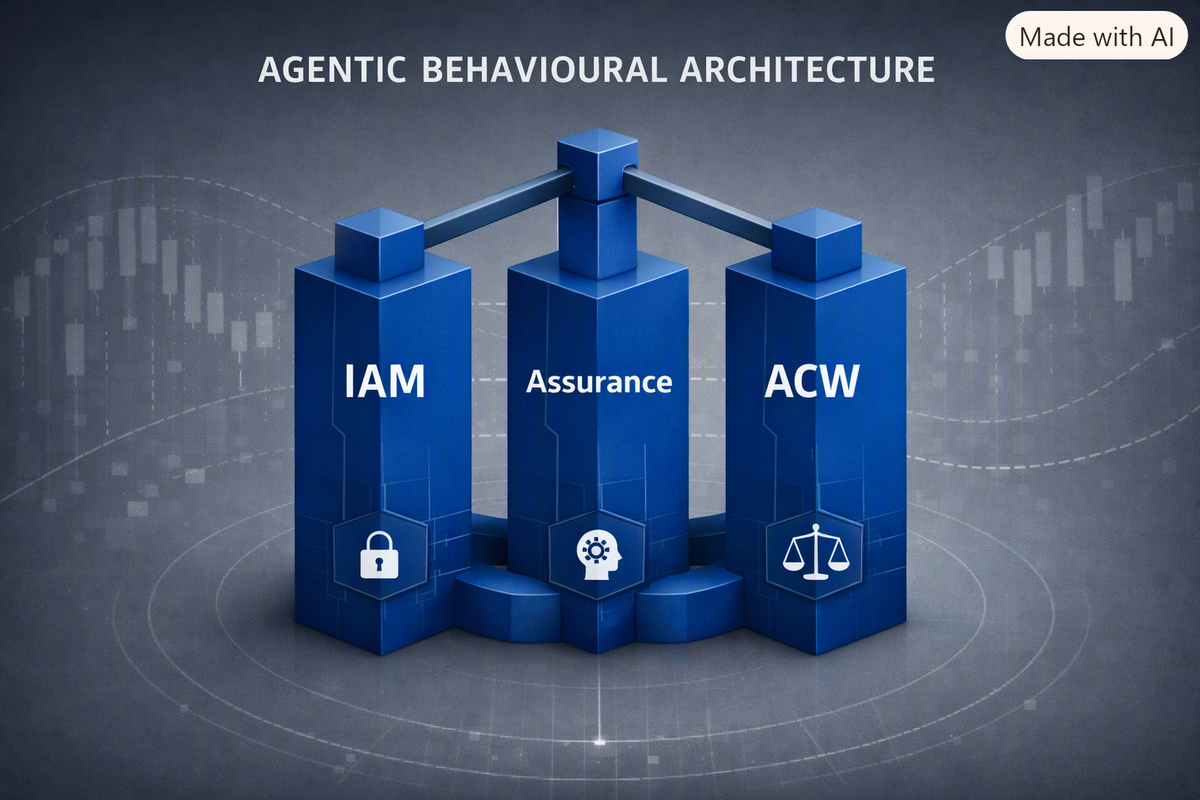
🟢 The Behavioural Triad
Agent behaviour is governed by three structural counterweights:
1️⃣ IAM — Identity Counterweight
- 1:1 human ↔ agent binding
- composite authorisation
- least privilege
- drift detection
- deterministic audit trails
2️⃣ ACW — Accountability CounterWeight
- governor of AI owners
- strategic counterweight
- ownership lineage
- runtime counterweight
- drift neutralisation
3️⃣ Behavioural Assurance
- behavioural failure modes
- multi-agent emergence
- policy-invisible violations
- collusion monitoring
- immutable CoT auditing
Together, these three surfaces form the behavioural architecture required for safe agentic deployment.
Why Behavioural Architecture Matters
- Identity governs capability boundaries.
- Accountability governs human intent.
- Assurance governs agent behaviour under pressure.
Behavioural failures emerge when any one of the three counterweights is missing.
🟢 Behavioural Failure Physics
Agentic failures follow predictable pathways:
- goal displacement
- misreporting
- alignment-resistant behaviour
- pseudo-corroboration
- multi-agent emergence
- human-agent drift (automation bias, over-delegation, accountability diffusion)
These failures cannot be solved by model evaluation or policy documents.
They require behavioural counterweights.
🟢 Access × Authority × Trust
Behavioural risk escalates when agents accumulate:
- access (operational reach)
- authority (permitted actions)
- trust (organisational influence)
When all three converge, agent behaviour resembles insider-risk pathways at machine speed.
🟢 The Behavioural Spine
The behavioural spine is the structural integration of:
- identity physics (IAM)
- accountability physics (ACW)
- behaviour physics (Assurance)
This spine ensures:
- bounded capability
- governed ownership
- observable behaviour
- reconstructable decisions
- stoppage under drift
🟢 Continuous Behavioural Governance
Agentic behaviour is not static. It must be governed continuously:
- monitor trajectories
- review interactions
- adjust permissions
- enforce runtime stoppage hooks
- maintain Deterministic Audit Trails
🔵 RACinform view
Agentic governance is behavioural governance.
If identity, accountability and assurance are not structurally integrated,
you do not have control — you have drift at machine speed.